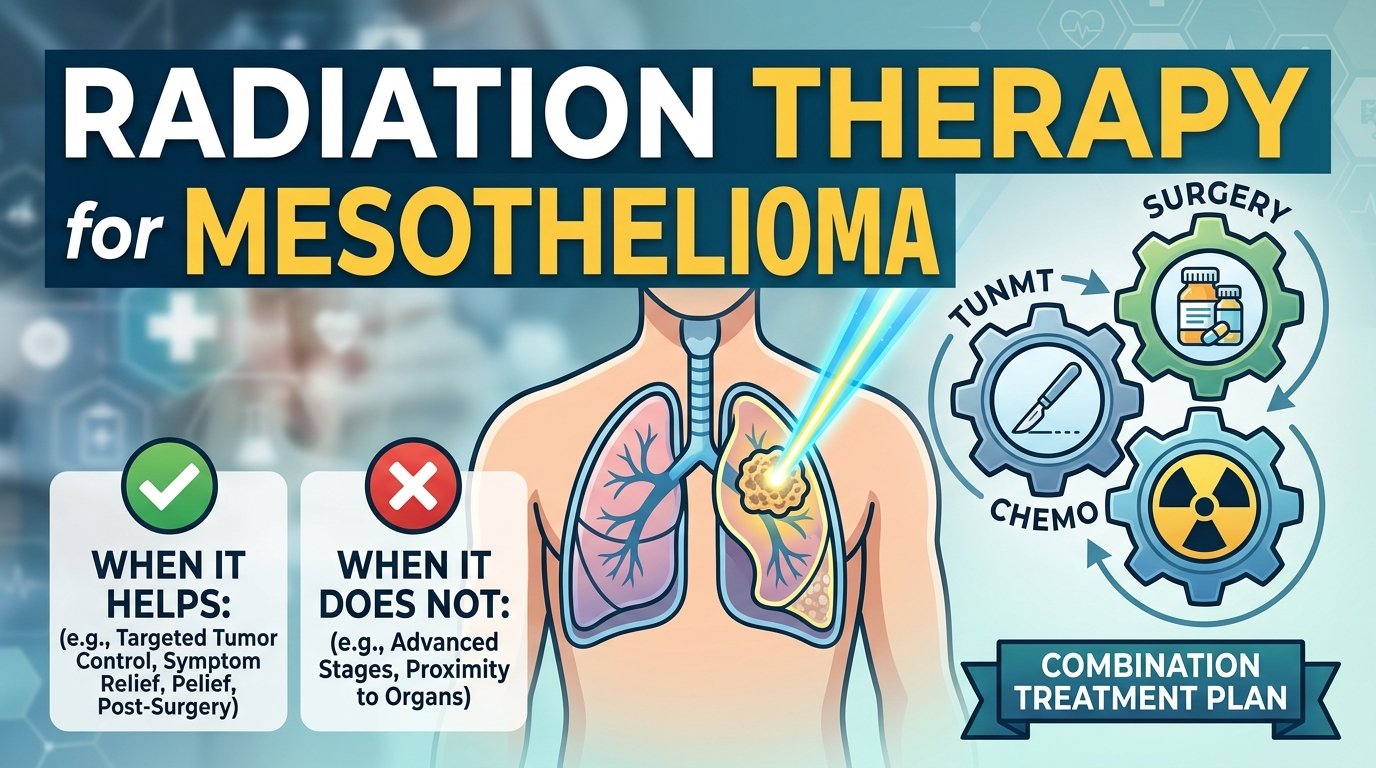
Your team mentioned radiation. They were vague about whether it would actually help you. The reason is that radiation’s role in mesothelioma is more limited and more targeted than for many other cancers. It is not a primary treatment in most cases. It has specific roles where it works well, and other situations where it does not help.
This guide explains mesothelioma radiation therapy in plain language. You will learn when radiation is useful, when it is not, what the experience of treatment is like, what side effects to expect, and how it fits with surgery and other treatments. The goal is to help you have a meaningful conversation with your radiation oncologist.

Why Radiation Is Tricky in Mesothelioma
Mesothelioma is a difficult cancer for radiation because the tumour grows in a thin, sheet-like pattern across large surfaces inside the chest or abdomen. Conventional radiation works best on focal tumours that can be targeted as a single mass. Mesothelioma’s diffuse growth pattern requires either treating large volumes of tissue, which damages healthy organs, or treating only specific areas, which leaves disease untreated elsewhere.
Modern radiation techniques like intensity-modulated radiation therapy and proton beam therapy have improved the precision of treatment. The doses can now conform to complex tumour shapes and spare nearby organs better than older techniques. Even with these advances, radiation in mesothelioma is generally used for specific purposes rather than as the primary treatment.
Three Common Uses of Radiation in Mesothelioma
Radiation has three established roles in mesothelioma care. The first is hemithoracic radiation after EPP surgery. After the entire lung has been removed, the empty cavity can be radiated to kill any residual disease cells lining the chest wall. This was a standard part of the trimodality protocol that combined chemotherapy, EPP, and radiation. It is used less often now that P/D has displaced EPP as the more common surgical approach.
The second is palliative radiation for symptom control. Pain from chest wall tumour invasion, breathing difficulty from large tumour masses pressing on airways, and other localised symptoms can often be relieved with focused radiation. The doses are lower than curative-intent radiation. The treatment courses are short, often a single fraction or a week of daily treatments. Symptom relief is the goal and is usually achieved.
The third is prevention of seeding metastases. Mesothelioma can spread along the tracks created by surgical instruments or biopsy needles, producing skin lumps at incision sites that can be painful and disfiguring. Prophylactic radiation to these sites soon after a procedure can reduce this complication. The evidence for routine prophylactic radiation is mixed, and practice varies between centres.
What the Treatment Process Looks Like
Radiation therapy begins with a planning session called simulation. You lie on a treatment table while imaging studies are performed to map the exact location of the tumour and surrounding organs. The radiation oncologist uses these images to design a treatment plan that delivers the prescribed dose to the target while sparing healthy tissue as much as possible.
Treatment is then delivered over a series of daily sessions, typically Monday through Friday for several weeks. Each session takes fifteen to thirty minutes. The actual radiation delivery is brief, often less than five minutes. Most of the appointment time is spent positioning you precisely on the table to match the planning images. You feel nothing during the radiation itself.
Side effects develop over the course of treatment and persist for weeks afterward. Skin redness or tenderness in the radiation field is common. Fatigue accumulates. If radiation is being delivered to the chest, oesophageal irritation can cause swallowing discomfort. Cough and shortness of breath can develop temporarily as nearby lung tissue reacts. These typically resolve over weeks to months after treatment ends.
Proton Beam Therapy as an Option
Proton beam therapy uses charged particles instead of standard X-rays. Protons deposit most of their energy at a specific depth and stop, rather than continuing through tissue like X-rays. This property allows proton radiation to target tumour deeply while delivering minimal dose beyond the target. For mesothelioma, where critical organs surround the tumour, proton therapy can offer dose advantages.
Proton centres are less common than standard radiation centres. Insurance coverage is variable. The clinical evidence for proton over standard radiation in mesothelioma is still developing. Some mesothelioma treatment centers have proton facilities and use them for selected cases. If proton is an option locally, ask the radiation oncologist whether your specific situation would benefit.
Radiation in the Modern Treatment Landscape
Radiation’s role has narrowed as immunotherapy and improved chemotherapy combinations have produced more effective systemic treatments. The all-of-the-above trimodality protocols of fifteen years ago have given way to more selective use of radiation. The shift reflects evolving evidence about what helps and what just adds toxicity.
That said, radiation remains an important tool in the toolkit. For specific surgical patients, for symptom control, and for selected research protocols, it produces real benefits. The decision to use or not use radiation in a given patient is made by a multidisciplinary team that includes radiation oncology, medical oncology, and surgery. The conversation should be specific to your case rather than a generic recommendation.
Questions to Ask Your Radiation Oncologist
If radiation is being recommended for your mesothelioma treatment, ask the radiation oncologist these specific questions. What is the goal of radiation in my case, cure or symptom control. What dose and fractionation schedule are you planning. What are the expected side effects given my anatomy and prior treatments. Could proton beam therapy improve the dose distribution. What is the alternative if I decline radiation. The answers will let you make an informed decision.
Get a second opinion at another centre if you are uncertain. Major mesothelioma treatment centers have differing radiation philosophies, and the variation is real. The right answer for you depends on your tumour, your prior treatments, your goals, and your tolerance for the side effects involved.
This article is for educational purposes and does not replace personalised guidance from a radiation oncologist. Treatment decisions are individual.