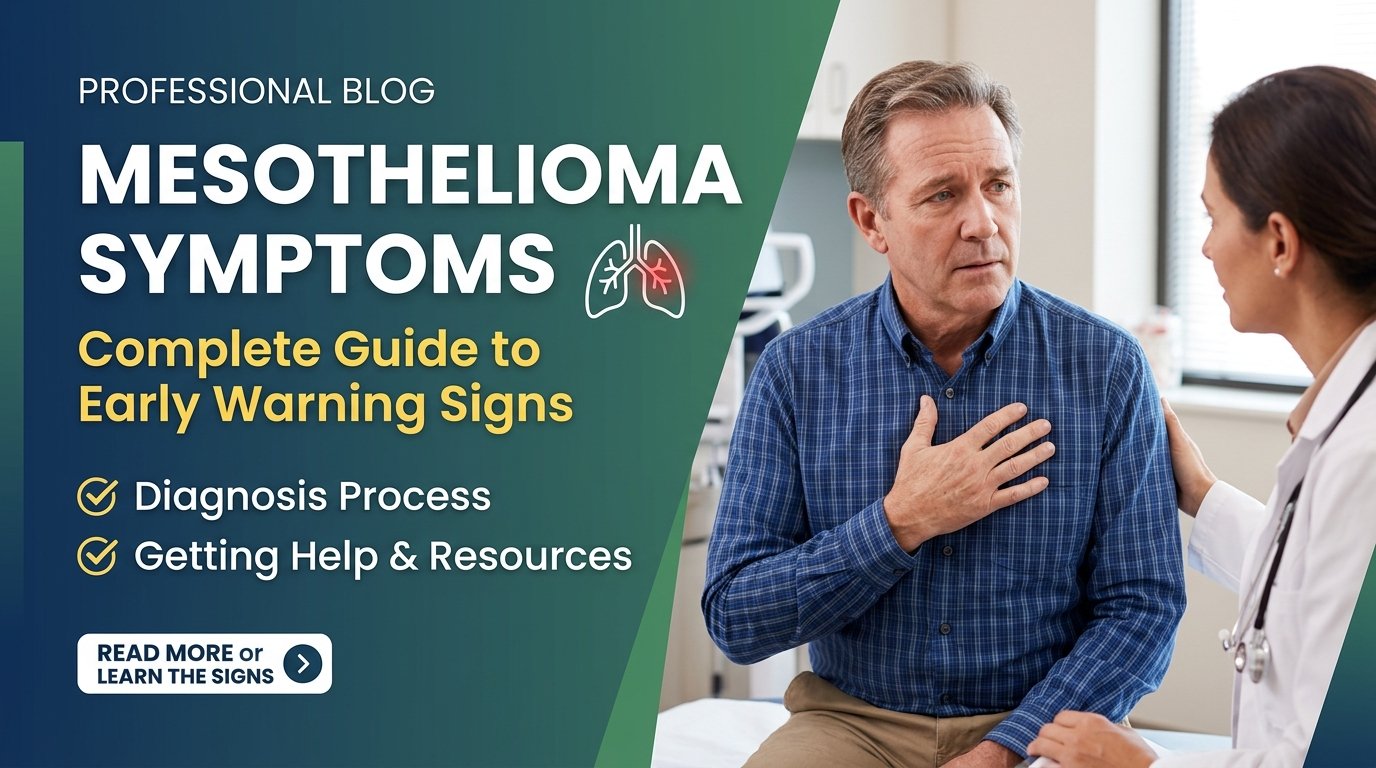
The Symptoms You Should Never Ignore
You have been feeling off for a while. Short of breath after climbing stairs. A dry cough that will not go away. Pain in your chest or belly. You are tired all the time. You have lost weight without trying.
You think it is just getting older. Maybe you need to lose weight. Maybe it is just stress. You push through. You ignore it.
But here is the thing. If you worked around asbestos decades ago, these symptoms could be early signs of mesothelioma.
Mesothelioma is a rare and aggressive cancer caused almost exclusively by asbestos exposure. The symptoms are often vague. They look like many other, less serious illnesses. That is why mesothelioma is usually diagnosed at a late stage.
But you can change that. By knowing the symptoms and seeing a doctor early, you can catch this disease sooner. And sooner means more treatment options and a better chance of living longer.
This guide will walk you through everything you need to know about mesothelioma symptoms. You will learn the early warning signs for each type of mesothelioma, how the disease is diagnosed, what tests to expect, what questions to ask your doctor, and what to do if you have symptoms.
No complicated medical language. No fear-mongering. Just clear, honest information to help you protect your health.
What Is Mesothelioma?
Let us start with a quick reminder.
Mesothelioma is a cancer that affects the mesothelium. The mesothelium is the thin layer of tissue that covers your internal organs. It protects your organs and helps them move smoothly against each other.
There are four types of mesothelioma, based on where the cancer starts.
- Pleural mesothelioma: affects the tissue around the lungs. This is the most common type, accounting for 75 to 80 percent of cases.
- Peritoneal mesothelioma: affects the tissue around the abdomen. This accounts for 10 to 20 percent of cases.
- Pericardial mesothelioma: affects the tissue around the heart. This is very rare.
- Testicular mesothelioma: affects the tissue around the testicles. This is extremely rare.
The symptoms are different for each type.

Why Mesothelioma Symptoms Are Often Missed
Here is the problem. The early symptoms of mesothelioma are vague. They can be caused by many things. Pneumonia. The flu. Old age. Allergies. Heartburn. Indigestion.
Most doctors have never seen a case of mesothelioma. It is a rare cancer. When you go to your doctor with a cough and chest pain, they are not thinking about mesothelioma. They are thinking about bronchitis, pneumonia, or acid reflux.
That is why you need to be your own advocate. If you have symptoms and you know you were exposed to asbestos, you must tell your doctor. Do not assume they will ask. Many doctors do not.
Pleural Mesothelioma Symptoms
Pleural mesothelioma affects the tissue around the lungs. These are the most common symptoms.
Early Symptoms of Pleural Mesothelioma
In the early stages, symptoms are often mild. You might not even notice them at first.
Shortness of breath: This is often the first symptom. You might notice it when climbing stairs or walking uphill. Over time, it gets worse. You might feel short of breath just sitting still.
Chest pain: A dull ache or sharp pain in your chest or under your ribcage. The pain may get worse when you take a deep breath, cough, or laugh.
Dry cough: A persistent cough that does not produce phlegm. It does not go away after a few weeks. It just keeps going.
Fatigue: Feeling unusually tired. You might need to rest after activities that never tired you before.
Unexplained weight loss: Losing weight without dieting or exercising. This is a common sign of many cancers.
Later Symptoms of Pleural Mesothelioma
As the cancer grows, symptoms become more severe.
Severe shortness of breath: You may feel like you cannot get enough air even when resting. Fluid builds up around the lung, pressing on it and making it hard to breathe.
Severe chest pain: The pain may become constant and severe. It may spread to your shoulder or arm.
Difficulty swallowing: The tumor can press on your esophagus, making it hard to swallow food or liquids.
Hoarseness: The tumor can press on nerves that control your vocal cords, making your voice sound different.
Swelling in your face or arms: The tumor can press on blood vessels, blocking blood flow and causing swelling.
Coughing up blood: This is a serious symptom. If you cough up blood, see a doctor immediately.
Lumps under your skin: In some cases, tumors can grow under the skin on your chest.
Pleural Mesothelioma Symptoms Summary
| Early Symptoms | Later Symptoms |
|---|---|
| Shortness of breath | Severe shortness of breath |
| Chest pain | Severe chest pain |
| Dry cough | Difficulty swallowing |
| Fatigue | Hoarseness |
| Unexplained weight loss | Swelling in face or arms |
| Night sweats | Coughing up blood |
| Fever | Lumps under skin |

Peritoneal Mesothelioma Symptoms
Peritoneal mesothelioma affects the tissue around the abdomen. These symptoms are different from pleural mesothelioma.
Early Symptoms of Peritoneal Mesothelioma
Abdominal pain: Pain or discomfort in your belly. It may be a dull ache or sharp pain.
Abdominal swelling: Your belly may look bigger than usual. This is often caused by fluid buildup in the abdomen, a condition called ascites.
Nausea and vomiting: Feeling sick to your stomach. You may actually throw up.
Loss of appetite: You are not hungry. Food does not appeal to you.
Unexplained weight loss: You are losing weight without trying, even though your belly is getting bigger.
Fatigue: Feeling unusually tired.
Later Symptoms of Peritoneal Mesothelioma
Severe abdominal pain: The pain becomes constant and severe.
Severe abdominal swelling: Your belly becomes very large and uncomfortable.
Bowel changes: You may have diarrhea or constipation that does not go away.
Bowel obstruction: The tumor can block your intestines, causing severe pain, vomiting, and inability to have bowel movements. This is a medical emergency.
Anemia: Low red blood cell count. This can cause fatigue, weakness, and pale skin.
Fever and night sweats: These are common in many cancers.
Lumps under your skin: In some cases, tumors can grow under the skin on your belly.
Peritoneal Mesothelioma Symptoms Summary
| Early Symptoms | Later Symptoms |
|---|---|
| Abdominal pain | Severe abdominal pain |
| Abdominal swelling | Severe abdominal swelling |
| Nausea and vomiting | Bowel changes |
| Loss of appetite | Bowel obstruction |
| Unexplained weight loss | Anemia |
| Fatigue | Fever and night sweats |
| Lumps under skin |
Other Types of Mesothelioma Symptoms
Pericardial Mesothelioma Symptoms
Pericardial mesothelioma is very rare. It affects the tissue around the heart.
Symptoms include:
- Chest pain
- Heart palpitations (feeling like your heart is racing or skipping beats)
- Irregular heartbeat
- Shortness of breath
- Fatigue
- Swelling in your legs or feet
Testicular Mesothelioma Symptoms
Testicular mesothelioma is extremely rare. It affects the tissue around the testicles.
The main symptom is a lump or swelling in the testicle. Some men also have pain.
How Long Does It Take for Symptoms to Appear?
Here is the most important thing to understand about mesothelioma. The time between asbestos exposure and the appearance of symptoms is very long. Usually 20 to 50 years.
You might have been exposed to asbestos in the 1970s or 1980s. You might have worked in a shipyard, a construction site, or a factory. You might have served in the Navy. You might have lived with someone who brought asbestos home on their work clothes.
Decades passed. You thought you were fine.
Now, 30 or 40 years later, you are getting symptoms. You do not connect them to that job you had back in the 1980s. But that is exactly when the damage started.
If you have symptoms and you know you were exposed to asbestos, even if it was 50 years ago, tell your doctor.
How Is Mesothelioma Diagnosed?
If your doctor suspects mesothelioma, they will order several tests.
Step One: Tell Your Doctor About Your Asbestos Exposure
This is the most important step. Many doctors do not ask about asbestos exposure. You must tell them. Say, “I was exposed to asbestos 30 years ago when I worked in a shipyard. Could my symptoms be related?”
That question could save your life.
Step Two: Imaging Scans
The first tests are usually imaging scans.
Chest X-ray: This can show fluid around the lungs or thickening of the pleura. It can also show tumors if they are large enough.
CT scan: This gives a much more detailed picture than an X-ray. It can show small tumors, fluid buildup, and whether the cancer has spread.
MRI: This is sometimes used to get even more detailed images, especially for peritoneal mesothelioma.
PET scan: This scan shows areas of your body that are metabolically active. Cancer cells are very active, so they light up on a PET scan. This helps doctors see if the cancer has spread.
Step Three: Blood Tests
There is no blood test that can definitively diagnose mesothelioma. However, there are blood tests that look for substances that are often elevated in people with mesothelioma.
These tests can help doctors decide if a biopsy is needed. They are not used alone to diagnose mesothelioma.
Step Four: Biopsy
A biopsy is the only way to know for sure if you have mesothelioma. A doctor takes a small sample of tissue from the suspicious area. A pathologist looks at it under a microscope.
If cancer cells are present, the pathologist can tell what type of cancer it is and what type of mesothelioma cells you have.
Types of biopsies include:
Needle biopsy: A thin needle is inserted through your skin to take a small tissue sample. This is the least invasive but sometimes does not get enough tissue.
Thoracoscopy (for pleural mesothelioma): A small camera is inserted through a tiny cut in your chest. The doctor can see the pleura and take tissue samples.
Laparoscopy (for peritoneal mesothelioma): A small camera is inserted through a tiny cut in your abdomen. The doctor can see the peritoneum and take tissue samples.
Thoracotomy or laparotomy: In some cases, surgery is needed to get a larger tissue sample.
Step Five: Staging
If you are diagnosed with mesothelioma, your doctor will determine the stage. Staging tells you how far the cancer has spread.
- Stage 1: The cancer is in one area and has not spread.
- Stage 2: The cancer has spread to nearby tissues but is still localized.
- Stage 3: The cancer has spread to nearby lymph nodes or tissues.
- Stage 4: The cancer has spread to distant parts of the body.
Early stage mesothelioma has more treatment options and a better prognosis.
Questions to Ask Your Doctor
If you are being tested for mesothelioma, ask these questions.
- Could my symptoms be related to my asbestos exposure?
- What tests do I need to diagnose mesothelioma?
- How long will it take to get the results?
- If I have mesothelioma, what stage is it?
- What are my treatment options?
- Should I see a mesothelioma specialist?
What to Do If You Have Symptoms
If you have symptoms of mesothelioma and you know you were exposed to asbestos, do not wait. See a doctor.
- Make an appointment with your primary care doctor.
- Tell them about your asbestos exposure. Say when, where, and how you were exposed.
- Describe your symptoms. Be honest about how bad they are and how long you have had them.
- Ask for tests. If your doctor does not suggest them, ask about X-rays or a CT scan.
- Get a second opinion. If you are not satisfied with your doctor’s response, see another doctor.
What If Your Doctor Dismisses Your Concerns?
Some doctors do not know much about mesothelioma. They may tell you your symptoms are from something else. They may say you are too young. They may say you could not have mesothelioma because it is rare.
If your doctor dismisses your concerns, see another doctor. You have the right to a second opinion. You have the right to be tested.
Do not let a dismissive doctor delay your diagnosis.
What If You Were Exposed to Asbestos But Have No Symptoms?
If you were exposed to asbestos but have no symptoms, what should you do?
- Tell your doctor about your exposure. Make sure it is in your medical record.
- Get a baseline chest X-ray or CT scan. This gives your doctor something to compare to in the future.
- Quit smoking if you smoke. Smokers who were exposed to asbestos have a much higher risk of lung cancer.
- Watch for symptoms. Know the early warning signs.
- Get regular check-ups. See your doctor every year.
Frequently Asked Questions
Can you have mesothelioma without symptoms?
In the earliest stages, yes. Many people have no symptoms at all when they are first diagnosed. The cancer is often found on a routine chest X-ray or CT scan done for another reason.
How long after asbestos exposure do symptoms appear?
Usually 20 to 50 years. The average is about 30 to 40 years. This makes it hard to connect the symptoms to the exposure.
What does mesothelioma pain feel like?
Chest pain from pleural mesothelioma often feels like a dull ache or sharp pain under your ribcage. It may get worse when you breathe deeply, cough, or laugh. Abdominal pain from peritoneal mesothelioma often feels like cramping or a dull ache.
Can mesothelioma be misdiagnosed?
Yes. It is often misdiagnosed as pneumonia, bronchitis, lung cancer (not mesothelioma), or other lung conditions. That is why telling your doctor about asbestos exposure is so important.
Is mesothelioma always fatal?
Mesothelioma is a serious cancer with a poor prognosis. But new treatments are helping people live longer. Some people have lived for years or even decades after diagnosis. Do not give up hope.
Hope and Action
A mesothelioma diagnosis is devastating. But the earlier you are diagnosed, the more treatment options you have. The longer you are likely to live.
Do not ignore your symptoms. Do not assume they are just from getting older. If you worked around asbestos, even decades ago, you are at risk.
See a doctor. Tell them about your exposure. Get tested.
And if you are diagnosed, call a lawyer. You may be entitled to significant financial compensation. The companies that made asbestos products knew the danger. They hid the truth. They should pay for the harm they caused.
You are not alone. There are doctors, lawyers, and support groups ready to help you.
Take the first step today.
Disclaimer: This article provides general information about mesothelioma symptoms and diagnosis. It does not constitute medical advice. Every patient’s situation is different. If you have symptoms that concern you, see a doctor immediately. If you know or suspect you were exposed to asbestos, tell your doctor. Early diagnosis saves lives. If you or a loved one has been diagnosed with mesothelioma, speak with a doctor immediately and contact a qualified mesothelioma lawyer to understand your legal rights.