Holly Tran is Research Editor at Teernight, where she covers the compensation side of asbestos disease: asbestos trust funds, mesothelioma lawsuits, settlements, statutes of limitations by state, VA disability ratings, and the practical steps families take after a diagnosis or wrongful-death loss. Her writing focuses on what readers actually need to do, in what order, and within what deadlines, without recommending a specific law firm. Holly comes from a research and policy-writing background, with prior coverage of veterans benefits, occupational health regulation, and consumer-protection law. Holly is not an attorney and does not provide legal advice. Reading her articles does not create an attorney-client relationship. Articles are sourced from primary statutes, published asbestos trust governance documents, the Department of Veterans Affairs, and reported case law. For corrections or topic suggestions related to Holly's coverage, contact support@teernight.live with the subject [Editorial].
The VA Compensation and Pension exam is a key step in establishing service-connected disability for mesothelioma. The exam evaluates the veteran’s medical condition and helps the VA decide the disability rating. Going in prepared makes a meaningful difference.
This guide explains VA C&P exams for mesothelioma in plain language. You will learn what the exam covers, what to bring, what questions to expect, and how the results affect your disability rating.
VA C&P exams establish the medical basis for service-connected disability ratings.
What the Exam Is For
The C&P exam is a medical examination performed by a VA or contracted physician. The purpose is to document your current medical condition and how it affects your daily functioning. The findings help the VA assign a disability rating that determines your monthly compensation.
For mesothelioma, the exam typically establishes the diagnosis, the impact on breathing and energy, the prognosis, and the connection to military asbestos exposure. The examiner reviews medical records, asks about symptoms, and performs a physical examination.
What to Bring
Bring all medical records related to your mesothelioma diagnosis: pathology reports, imaging studies, treatment summaries, and current medication list. Bring your military service records, particularly your DD-214 and any documentation of asbestos exposure during service. Bring a list of your current symptoms and how they affect your daily activities.
Bring a family member or friend if possible. Having another person present helps you remember what was discussed and provides support. The companion can also speak to changes in your functioning that you might minimise or forget.
Documentation of service-connected exposure supports the C&P examiner’s findings.
Questions to Expect
The examiner will ask about when you were diagnosed, what treatments you have received, what symptoms you currently experience, how the disease affects your ability to work, how it affects your daily activities, and what your prognosis is according to your treating oncologist. They will also ask about your military service and any asbestos exposure during it.
Be specific and concrete in your answers. Do not minimise. Veterans who answer questions about their functioning by saying “I’m fine” or “I manage” often receive lower disability ratings than their condition warrants. Describe what you actually cannot do, how often you tire, how often you have pain, and how much help you need.
The Disability Rating
Mesothelioma typically receives a 100 percent disability rating. The VA uses a schedule of ratings that assigns percentages to specific conditions. Active mesothelioma at the 100 percent rating produces the maximum monthly compensation. The rating is reviewed periodically. If the disease enters remission for an extended period, the rating may be reduced over time.
Special Monthly Compensation may apply on top of the 100 percent rating when the veteran needs additional support. Aid and Attendance, Housebound, and other categories provide additional monthly payments when the veteran requires care assistance.
After the Exam
The examiner submits a written report to the VA. The VA then issues a rating decision based on the report and other evidence. The decision is mailed to the veteran. If the rating is satisfactory, monthly compensation begins. If the rating is too low or service connection is denied, the veteran can appeal.
VA appeals are common in complex disability cases. The Higher-Level Review and Board of Veterans’ Appeals processes allow review by senior decision-makers. Veteran service organisations and accredited VA representatives can help with appeals.
Closing Note
The C&P exam is your opportunity to ensure the VA understands the full impact of mesothelioma on your life. Prepare carefully. Bring documentation. Be specific. Ask questions if anything is unclear. The exam outcome shapes your monthly compensation and benefits for years to come.
This article is informational and does not replace personalised guidance from a VA-accredited representative or attorney.
Asbestos exposure patterns differed significantly across military service branches. Navy veterans had heavy exposure aboard ships. Marines had exposure on bases and aboard ships. Army veterans encountered asbestos in vehicle maintenance and engineering activities. Air Force veterans had exposure to brake systems and base infrastructure. Each branch’s exposure profile shapes how mesothelioma claims are documented.
This guide explains mesothelioma veterans compensation by service branch in plain language. You will learn the specific exposure patterns, common occupational specialties, and documentation pathways for each major branch.
Asbestos exposure patterns differ by military branch and occupational specialty.
Navy Veterans
Navy veterans constitute the largest single group of mesothelioma cases among veterans. The reason is that ships built before the 1980s used extensive asbestos in insulation, gaskets, brakes, valves, and many other components. Sailors who served aboard those ships were routinely exposed during normal operations and especially during repairs and overhauls.
Specific high-exposure roles included boiler tenders, machinist’s mates, hull technicians, pipefitters, electricians, damage control specialists, and many other ratings that worked in engineering spaces. Service aboard certain ships and during certain time periods is particularly associated with elevated exposure risk. Ship-specific records can support exposure documentation.
Marine Corps Veterans
Marine veterans had asbestos exposure both aboard Navy ships during deployments and at land-based facilities. Camp Lejeune water contamination affects a separate but overlapping group. Marines in maintenance roles, vehicle mechanics, motor pool personnel, and base infrastructure workers had specific exposure patterns. Combat engineers and explosive ordnance disposal personnel had occasional exposure during demolition work that disturbed asbestos materials.
Service-connected mesothelioma compensation respects the asbestos exposure veterans incurred.
Army Veterans
Army exposure patterns centred on vehicle maintenance, particularly brake and clutch work that involved asbestos-containing friction materials. Engineers, motor pool personnel, and maintenance specialists had ongoing exposure. Construction battalions and engineering units had exposure during base construction and repair activities involving asbestos products.
Army veterans who served in older buildings on stateside or overseas posts also had passive exposure from deteriorating insulation and infrastructure. The VA recognises these exposure patterns and accepts evidence of military occupational specialties consistent with asbestos work as supporting documentation.
Air Force Veterans
Air Force exposures were concentrated in aircraft maintenance, particularly brake systems and certain engine components, and in base infrastructure built during the asbestos era. Crew chiefs, maintenance technicians, fire fighters, and base civil engineers had exposure patterns that the VA recognises.
Aircrew personnel had less direct exposure but still encountered asbestos in cockpits, support equipment, and ground operations. Documentation of specific roles and time periods supports VA disability claims.
Coast Guard Veterans
Coast Guard veterans aboard older cutters had exposure patterns similar to Navy veterans. Engineering personnel, machinist’s mates, and other technical ratings worked in spaces with asbestos insulation and components. Shore-based personnel at older facilities had passive exposure to deteriorating materials.
The Coast Guard’s smaller size meant fewer total cases but the per-veteran exposure pattern in technical roles was substantial. VA recognition of Coast Guard mesothelioma claims follows the same standards as other branches.
Documentation Specifics by Branch
Each branch maintains detailed records of unit assignments, occupational specialties, and ship or aircraft assignments. The VA can request these records when supporting a claim. Veterans should provide their DD-214, occupational specialty codes, and detailed service histories. Buddy statements from fellow service members who can corroborate exposure activities also help.
Specialty firms experienced in veteran mesothelioma claims work with each branch’s record systems. They know what evidence to request, what specific occupational codes indicate exposure, and how to present the case for the strongest possible disability rating.
Closing Note
Veterans with mesothelioma have established compensation pathways through the VA disability system regardless of which branch they served in. The exposure patterns differ but the recognition is consistent. Documenting your specific service history and occupational specialty supports the strongest possible VA claim.
This article is informational and does not constitute legal advice. Consult a VA-accredited representative or attorney for guidance specific to your service history.
The 100 percent disability rating for service-connected mesothelioma is the foundation of VA compensation, but it is not the ceiling. Special Monthly Compensation, often abbreviated SMC, provides additional monthly payments on top of the base rating when the veteran meets specific criteria related to severity of disability.
This guide explains VA Special Monthly Compensation for mesothelioma veterans in plain language. You will learn about the SMC categories, how they apply to advanced mesothelioma, and how to apply for them.
SMC adds to the base disability rating when criteria are met.
SMC Categories Relevant to Mesothelioma
SMC has multiple categories. The categories most relevant to mesothelioma veterans include SMC-L for veterans who need regular aid and attendance from another person, SMC-S for housebound status, and SMC-T for veterans needing higher levels of care. The specific category depends on the veteran’s level of dependency on others for daily activities.
SMC-L Aid and Attendance applies when the veteran needs help with daily activities such as bathing, dressing, eating, or medication management. The 2026 monthly amount in addition to the base 100 percent rating is approximately 1,000 dollars to 4,400 dollars depending on the specific subcategory.
Housebound Status
SMC-S Housebound status applies when the veteran is substantially confined to home due to disability. This does not require the absolute inability to leave home but means that disability significantly limits the veteran to the home environment. Some mesothelioma patients in advanced stages qualify based on the combined effects of breathlessness, fatigue, and treatment side effects.
The SMC-S monthly amount is smaller than Aid and Attendance but still provides meaningful additional compensation.
SMC categories recognise the practical impact of advanced disability.
How to Apply
SMC is requested through the VA. The application requires medical evidence of the level of care needed. The VA Form 21-2680 is used to document Aid and Attendance needs. The treating physician fills out the form describing the veteran’s specific functional limitations and care requirements.
If the veteran is already at the 100 percent rating for mesothelioma, the SMC application is generally separate from but coordinated with the base claim. The VA reviews the medical evidence and decides which SMC category applies.
Surviving Spouse Aid and Attendance
Surviving spouses of veterans who died from service-connected mesothelioma may also be eligible for Aid and Attendance benefits if they need help with daily activities and meet financial criteria. This is separate from but coordinated with Dependency and Indemnity Compensation. Surviving spouses can apply for both.
The application uses VA Form 21-534EZ for surviving spouse pension benefits with Aid and Attendance enhancement. The financial means test does not apply to DIC but does apply to certain pension benefits. A VA-accredited representative can help with the application strategy.
Closing Note
Special Monthly Compensation provides important additional support for veterans with advanced mesothelioma and their surviving spouses. The categories address the real practical needs of patients in late-stage disease. Applying for SMC alongside the base disability rating maximises monthly support.
This article is informational and does not constitute legal advice. Consult a VA-accredited representative or attorney for specific guidance.
Caring for a mesothelioma patient is exhausting. Many caregivers are themselves spouses of veterans, often elderly, and have their own evolving care needs. The VA Aid and Attendance benefit can provide significant monthly compensation to support a surviving spouse’s care needs after the veteran has passed away.
This guide explains VA Aid and Attendance for mesothelioma spouses in plain language. You will learn the eligibility criteria, the application steps, what the benefit pays, and how to combine it with other VA survivor benefits.
Aid and Attendance recognises the daily care needs of surviving spouses.
Eligibility Basics
Aid and Attendance for surviving spouses of wartime veterans requires three elements. The deceased veteran must have served at least ninety days of active duty with at least one day during a wartime period. The spouse must have been married to the veteran for the required period under VA rules and not have remarried (or, if remarried, the subsequent marriage ended). The spouse must have ongoing care needs that meet specific criteria.
The care needs criteria include needing help with daily activities such as bathing, dressing, feeding, or toileting. Being bedridden. Living in a nursing facility. Or having significant cognitive or visual impairment. Mesothelioma’s impact on the surviving spouse’s own caregiving capacity often qualifies them for the benefit.
Financial Eligibility
Aid and Attendance has financial eligibility limits for the pension version. The combined assets and income of the spouse must fall below VA thresholds. Unreimbursed medical expenses, including cost of long-term care, can be deducted from income for the eligibility calculation. Many spouses qualify after these deductions even when their headline income would seem too high.
Note that DIC, the Dependency and Indemnity Compensation for surviving spouses of veterans who died from service-connected disease, does not have the same income test. Mesothelioma surviving spouses who qualify for DIC at any income level can also seek the Aid and Attendance enhancement.
The benefit supports paid caregiver costs and home care services.
Monthly Benefit Amounts
The 2026 maximum monthly Aid and Attendance benefit for a surviving spouse is approximately 1,500 dollars in addition to the base pension or DIC payment. The exact amount varies with countable income; spouses with higher countable income receive less, while spouses with low countable income or substantial unreimbursed medical expenses can receive the maximum.
For a spouse already receiving DIC, the Aid and Attendance enhancement adds to the base monthly DIC amount. The combined total can be substantial and provides meaningful support for paid caregiver costs, home health aide services, or assisted living facility expenses.
Application Process
The application uses VA Form 21-534EZ for surviving spouse benefits with the Aid and Attendance section completed. Supporting documents include the marriage certificate, the veteran’s death certificate, the veteran’s military service record (DD-214), evidence of the service-connected cause of death, and medical evidence of the spouse’s care needs.
Medical evidence of care needs comes from VA Form 21-2680, which the spouse’s physician completes. The form documents specific functional limitations and care requirements. Detailed and specific descriptions support the strongest claim.
Veteran service organisations including the American Legion, VFW, DAV, and Vietnam Veterans of America provide free help with applications. VA-accredited claims agents and attorneys also help, though they may charge fees for benefit increases. The VSOs are a no-cost first option for most surviving spouses.
Combining With Other Benefits
Aid and Attendance combines with DIC to produce a higher total monthly benefit for eligible surviving spouses. The combined amount can exceed three thousand dollars per month for spouses needing high levels of care. The benefit is tax-free and not counted against most state Medicaid eligibility tests.
The benefit can be used for any purpose. There is no requirement that it be spent specifically on care, although that is usually how recipients use it. Hiring a home health aide, paying for assisted living, supplementing other income, or saving for future needs all qualify.
Closing Note
Aid and Attendance is a meaningful but underused benefit for surviving spouses of veterans who died from mesothelioma. The application process is administrative. The benefit, once granted, continues for the spouse’s lifetime in most cases. Applying alongside DIC ensures that the surviving spouse receives the full support the VA system provides for service-connected losses.
This article is informational and does not constitute legal or financial advice. Consult a VA-accredited representative for guidance specific to your situation.
Billions of Dollars Are Waiting for People Like You
You worked hard all your life. You did not know that the dust you breathed at work was slowly killing you. Now you have mesothelioma, lung cancer, or asbestosis. You are facing expensive treatments. You cannot work. Your family is worried about money.
But here is something you might not know. There is over thirty billion dollars sitting in trust funds waiting for people just like you. That money was set aside by companies that made and sold asbestos products. They knew asbestos was dangerous. They hid the truth. Now they are paying for the harm they caused.
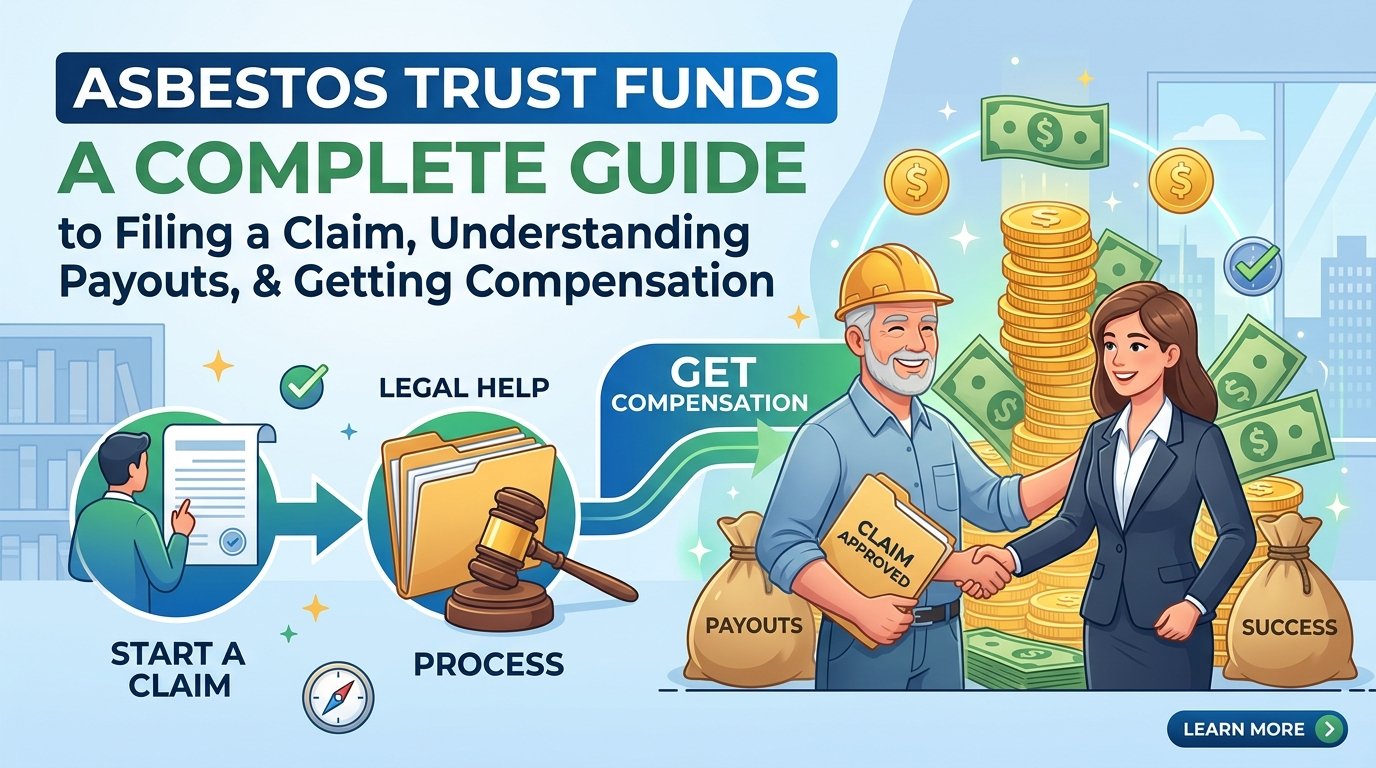
This guide will walk you through everything you need to know about asbestos trust funds. You will learn what they are, who created them, how much money is available, who can file a claim, how the process works, how much you might receive, and how to find a lawyer to help you.
No complicated legal language. No confusion. Just clear, honest information to help you and your family get the money you need and deserve.
What Is an Asbestos Trust Fund?
Let us start with the simple explanation.
For decades, companies made and sold asbestos products. They put asbestos in insulation, brakes, gaskets, pipe covering, ceiling tiles, floor tiles, and hundreds of other products. They knew asbestos was dangerous. They had secret documents proving they knew. But they kept selling it anyway. They did not warn workers. They did not warn the public.
Thousands of people got sick. Thousands of people died. Those people and their families started filing lawsuits. They won. They won big. Juries awarded millions and millions of dollars to victims.
Facing more and more lawsuits, many asbestos companies went bankrupt. But here is the important part. When they went bankrupt, courts did not let them just walk away. The courts said, “You caused this harm. You must pay.”
So the courts required these companies to set aside money in special funds. Those funds are called asbestos trust funds. The money in those funds is for victims of asbestos-related diseases like mesothelioma, lung cancer, and asbestosis.
Today, there are over sixty asbestos trust funds. Together, they hold more than thirty billion dollars. That money is sitting there right now, waiting for people like you to file a claim.
Attorney reviewing case file.
Which Companies Created Asbestos Trust Funds?
Many of the biggest industrial companies in American history created asbestos trust funds. Here are some of the most important ones.
Johns-Manville Trust Fund
Johns-Manville was one of the largest asbestos companies in the world. They made asbestos insulation, roofing, and many other products. Their own doctors warned them about the dangers in the 1930s. They hid the truth. They kept selling asbestos for decades. Their trust fund holds over two and a half billion dollars.
Owens Corning Trust Fund
Owens Corning made Fiberglas insulation, but they also made asbestos products for many years. Their trust fund holds over one and a half billion dollars.
W.R. Grace Trust Fund
W.R. Grace mined asbestos in Libby, Montana. The people of Libby suffered one of the worst asbestos disasters in American history. Thousands of miners and their families got sick. Their trust fund holds over one billion dollars.
Pittsburgh Corning Trust Fund
Pittsburgh Corning made Unibestos, a popular asbestos insulation product. Their trust fund holds over two billion dollars.
Armstrong Trust Fund
Armstrong made asbestos floor tiles and ceiling tiles. Their trust fund holds over one billion dollars.
Other Major Trust Funds
Celotex Trust Fund
GAF Trust Fund
National Gypsum Trust Fund
U.S. Gypsum Trust Fund
Keene Corporation Trust Fund
Owens-Illinois Trust Fund
Babcock & Wilcox Trust Fund
Combustion Engineering Trust Fund
AC&S (Armstrong) Trust Fund
Halliburton Trust Fund
And there are over forty more trust funds, each with hundreds of millions or billions of dollars.
Who Can File an Asbestos Trust Fund Claim?
You can file a claim with an asbestos trust fund if:
You have been diagnosed with an asbestos-related disease like mesothelioma, lung cancer, asbestosis, or other cancers
You were exposed to asbestos products made by a company that has a trust fund
You can show that your exposure came from that company’s products
What If You Do Not Know Where You Were Exposed?
Many people do not remember every job they ever had. They do not remember every product they worked with. That is okay. A good asbestos lawyer will help you figure it out.
Your lawyer will ask you questions about your work history. Where did you work? What did you do? What did you see? What did you handle? What tools did you use? What brands do you remember?
From your answers, your lawyer can figure out which products you were likely exposed to and which companies made them. Asbestos lawyers have huge databases of information about where specific asbestos products were used. They have investigators who can find old records and witnesses.
You do not need to remember everything. Your lawyer will help.
What If You Were Exposed Through Secondhand Exposure?
Many people were exposed because a family member brought asbestos fibers home on their work clothes. Wives who washed those clothes. Children who hugged their fathers. They got mesothelioma too.
The asbestos trust funds recognize secondhand exposure. You can file a claim. You will need to show that you lived with someone who worked around asbestos. Your lawyer can help with this.
What If Your Loved One Already Passed Away?
Yes. You can still file claims on their behalf. This is called a wrongful death claim. The money goes to the spouse, children, or other family members.
Do not wait. There are deadlines for filing these claims. Call a lawyer as soon as possible.
Legal documents and gavel.
The Asbestos Trust Fund Claim Process
The process for filing an asbestos claim with a trust fund is usually simpler and faster than a lawsuit. Here is how it works.
Step One: Identify Which Trust Funds Apply to You
Your lawyer will take a detailed work history. They will ask about every job you ever had. Your military service. Any time you might have been around asbestos.
Your lawyer will use this information to identify which companies likely exposed you to asbestos. Then they will determine which of those companies have trust funds.
Step Two: Gather Evidence
Your lawyer will gather evidence to support your claim. This includes:
Medical records showing your diagnosis
Work history records
Pay stubs, union records, or military records
Witness statements from coworkers who remember the products used
Product identification evidence showing that specific asbestos products were used where you worked
Your lawyer does most of this work. You focus on your health.
Step Three: File the Claim
Your lawyer files the claim with each trust fund. Each trust fund has its own forms and its own requirements. Some require extensive documentation. Others have simpler processes.
Your lawyer handles all of that.
Step Four: Trust Fund Reviews the Claim
The trust fund reviews your claim. They check the evidence. They make sure you qualify. They may ask for more information. This is called a “supplemental request.”
Your lawyer handles all communication with the trust fund.
Step Five: You Receive Payment
If your claim is approved, the trust fund sends a check. The money can be paid as a lump sum all at once or as periodic payments over time.
Your lawyer takes their agreed percentage. The rest goes to you.
How Much Money Can You Get from Asbestos Trust Funds?
This is the question everyone wants answered. The honest answer is that every trust fund is different. Each trust fund has its own rules and its own payment schedule.
How Trust Funds Determine Payouts
Most trust funds use a system called a “TDP” or Trust Distribution Procedure. The TDP assigns a certain dollar amount to each type of disease.
For example, a trust fund might have a schedule that says:
Mesothelioma: $200,000
Lung cancer with asbestosis: $50,000
Lung cancer without asbestosis: $25,000
Asbestosis: $15,000
Pleural plaques: $5,000
These are just examples. Every trust fund is different. Some pay more. Some pay less.
The Percentage Reduction
Here is the important thing to understand. Most trust funds do not pay 100 percent of the scheduled amount. They pay a percentage. This is because there is more money claimed than money in the trust fund.
The payment percentage varies by trust fund. Some pay 100 percent of the scheduled amount. Others pay as little as 10 percent.
For example, if a trust fund has a scheduled amount of 200,000formesotheliomaandispayingat50percent,youwouldreceive100,000 from that trust fund.
You Can File Claims with Multiple Trust Funds
Here is the best news. You can file claims with multiple trust funds. If you were exposed to products from ten different companies, you can file claims with all ten trust funds. Your total compensation can be the sum of all of them.
Many mesothelioma victims receive between 300,000and1 million from trust funds alone. Some receive even more.
Realistic Expectations for Mesothelioma Claims
Typical total compensation from trust funds: 300,000to1 million
Typical compensation for a single trust fund: 50,000to200,000
Typical compensation if you qualify for many trust funds: 500,000to1 million
Realistic Expectations for Lung Cancer Claims
Typical total compensation from trust funds: 100,000to500,000
Typical compensation for a single trust fund: 10,000to75,000
Realistic Expectations for Asbestosis Claims
Typical total compensation from trust funds: 30,000to150,000
How Long Does the Process Take?
This depends on the trust fund. Some trust funds process claims in a few months. Others take a year or more.
Some trust funds are very well funded and can pay quickly. Others have less money and have to stretch payments over time.
Your lawyer can give you an estimate based on which trust funds you are filing with.
Do You Need a Lawyer to File an Asbestos Trust Fund Claim?
Technically, you are allowed to file a claim yourself without a lawyer. But this is almost always a bad idea. Here is why.
The trust funds have complicated rules and deadlines. If you miss a deadline or fill out a form incorrectly, your claim can be denied. Even if it is eventually approved, mistakes can delay your payment by months or years.
The trust funds have experienced lawyers working for them. They know how to spot problems with claims. You want an experienced lawyer on your side who knows how to present your claim in the best possible way.
Also, a lawyer can file claims with multiple trust funds for you. Doing that yourself would be overwhelming, especially when you are sick and dealing with treatment.
Most importantly, asbestos lawyers work on contingency. You pay nothing upfront. They only get paid if you get paid. You have nothing to lose and potentially hundreds of thousands of dollars to gain.
How to Find a Good Asbestos Lawyer
You need a lawyer who specializes in asbestos cases. Do not hire a general personal injury lawyer. Asbestos trust fund claims are complicated. You need someone who does this work every day.
The best asbestos lawyer will:
Give you a free consultation
Work on contingency (you pay nothing upfront)
Have handled hundreds or thousands of asbestos trust fund claims
Know which trust funds are paying and how much
Be willing to travel to you
Do not worry about finding a lawyer in your city. Asbestos lawyers work with clients all over the country. They can handle everything by phone, mail, and email.
Questions to Ask Before Hiring a Lawyer
How many asbestos trust fund claims have you filed?
How much money have you recovered for clients from trust funds?
Do you also handle lawsuits against companies that are still in business?
Will you come to me, or do I need to travel to you?
What percentage do you take as your fee?
How Much Does a Lawyer Cost?
Nothing upfront. Asbestos lawyers work on contingency. That means they take a percentage of the money they win for you. Typical contingency fees for trust fund claims are 25 to 40 percent of the amount you receive.
If your lawyer does not win any money for you, you pay nothing. That is the deal.
Trust Funds vs. Lawsuits: Which Is Better?
Most people want to know whether they should file trust fund claims or file a lawsuit. The answer is usually both.
Trust funds: You file claims with bankrupt companies that had to set aside money. Trust funds pay faster, often in six to twelve months. The payouts are usually smaller than lawsuit verdicts, but they are more certain. Claimants almost never get turned down if they have a valid claim.
Lawsuits: You sue companies that are still in business and have not gone bankrupt. Lawsuits can result in larger payouts, sometimes several million dollars. But lawsuits take longer, sometimes two to four years, and there is a risk you could lose at trial.
The best strategy: Do both. File trust fund claims to get money quickly. At the same time, file lawsuits against companies that are still solvent. Your lawyer will handle everything.
What If You Already Filed a Lawsuit?
You can still file trust fund claims. Many people do both. The money from trust funds is in addition to any money you get from lawsuits.
However, there is an important rule. If you win a lawsuit against a company, you cannot also file a claim with that company’s trust fund. The trust fund is only for people who are not suing that specific company.
Your lawyer will make sure you do not double dip. They will help you get money from every source you are eligible for.
Frequently Asked Questions
How much money can I get from asbestos trust funds? Most mesothelioma victims receive between 300,000and1 million from trust funds. Most lung cancer victims receive between 100,000and500,000. Most asbestosis victims receive between 30,000and150,000.
How long does it take to get paid? Some trust funds pay in a few months. Others take a year or more. Your lawyer can give you an estimate.
Will my claim affect my VA benefits? No. VA benefits are separate. You can receive money from trust funds and VA disability payments at the same time.
Will trust fund payments affect my Social Security or Medicaid? Maybe. Trust fund payments are considered income. They could affect your eligibility for needs-based programs like Medicaid or SSI. Talk to your lawyer and a benefits specialist.
What if the company that exposed me is still in business? If the company is still in business and has not gone bankrupt, you will file a lawsuit, not a trust fund claim. Your lawyer can help with both.
What if I already filed a claim years ago and was denied? You may be able to file again. The rules have changed over time. What was denied years ago might be approved now. Talk to a lawyer.
Hope and Action
You have been through so much already. A terrifying diagnosis. Painful treatments. Worry about your family and your finances. You did not ask for any of this.
But here is the truth. There is over thirty billion dollars sitting in asbestos trust funds right now. That money was set aside for people just like you. It is your money. You deserve to get it.
Do not wait. Do not let fear or confusion stop you. Call a lawyer today. The call is free. The consultation is free. You pay nothing unless you win.
You can get money to pay your medical bills. You can get money to replace your lost income. You can get money to support your family.
Do it for yourself. Do it for your family. Take the first step today.
Disclaimer: This article provides general information about asbestos trust funds and filing claims. It does not constitute legal advice or financial advice. Every case is different. Trust fund rules vary. Always consult with a qualified asbestos attorney about your specific situation. If you or a loved one has been diagnosed with mesothelioma, lung cancer, or asbestosis, speak with a doctor immediately and contact a qualified asbestos lawyer to understand your legal rights.
You Served Your Country. Now Let Your Country Help You.
You raised your right hand and took an oath. You served on a ship, in a shipyard, or on a naval base. You worked in engine rooms, boiler rooms, or pipe shops. You did your job without complaint. You did not know that every day you were breathing in tiny asbestos fibers. No one told you it was dangerous. No one warned you.
Now, decades later, you are sick. Shortness of breath. A cough that will not go away. Chest pain. Maybe you have been diagnosed with mesothelioma, lung cancer, or asbestosis.
You are not alone. Thousands of Navy veterans have been diagnosed with asbestos-related diseases. The Navy used more asbestos than any other branch of the military. Ships built before the 1980s were filled with asbestos from bow to stern.
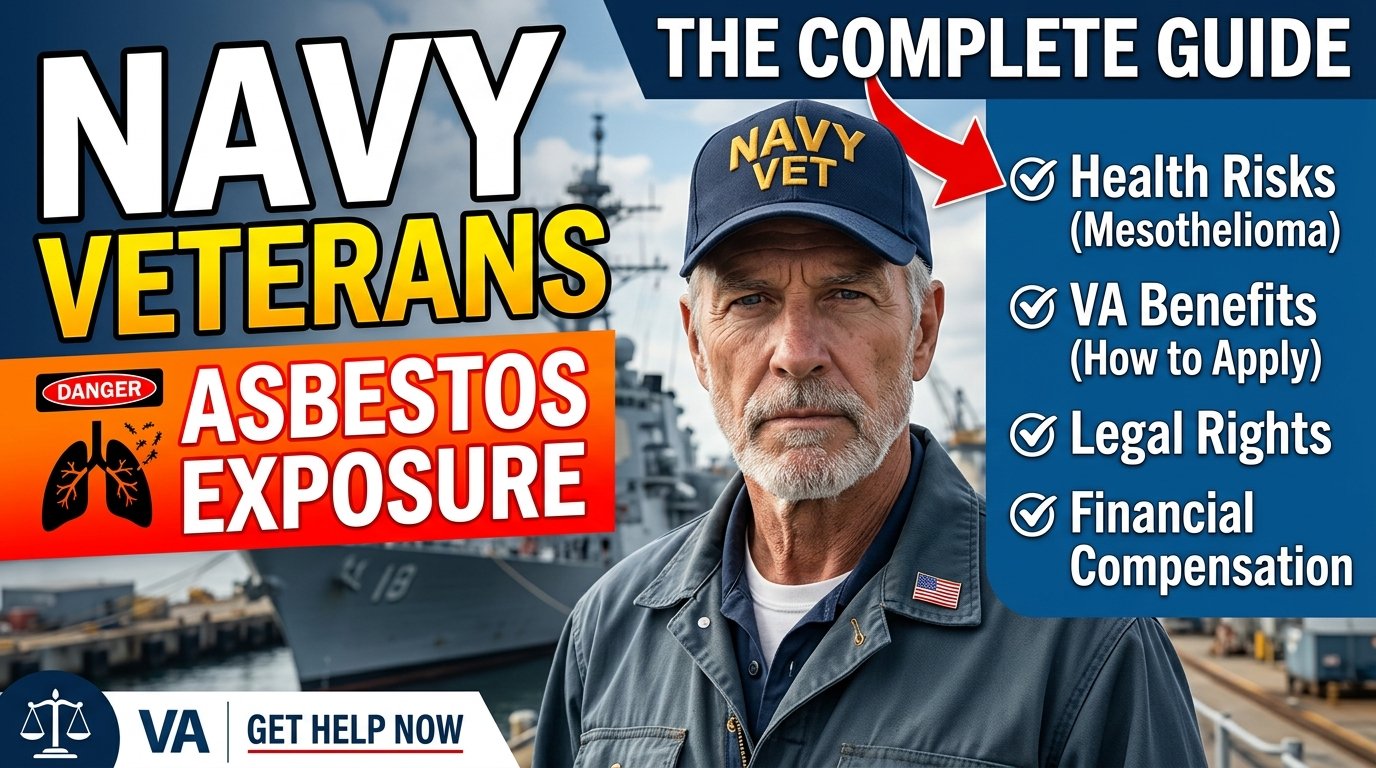
This guide is for you. You will learn why the Navy used so much asbestos, which jobs and ships had the highest exposure, what diseases are caused by asbestos, how to get VA benefits, how to file legal claims, and how to get the financial compensation you deserve. No complicated language. No confusion. Just clear, honest information to help you and your family.
Why the Navy Used So Much Asbestos
Asbestos was used extensively by the Navy for decades. Why? Because it was the perfect material for ships.
Asbestos is strong. It can withstand high temperatures. It does not burn. It is resistant to saltwater corrosion. It is an excellent insulator. And it was cheap.
On a ship, fire is the greatest danger. A fire at sea can be a death sentence. Asbestos was used to fireproof every part of the ship. It was used in engine rooms, boiler rooms, and fuel storage areas. It was used to insulate pipes, boilers, and turbines. It was used in gaskets, valves, pumps, and packing materials. It was used in wall panels, ceiling tiles, and floor tiles. It was used in electrical wiring, brake pads, and clutch plates.
Every ship built between the 1930s and the early 1980s was filled with asbestos. Thousands of tons of asbestos on a single ship.
The Navy knew asbestos was dangerous. They had studies showing the risks. But they kept using it anyway. They did not warn the sailors. They did not provide protective equipment. They did not train sailors on how to work safely with asbestos.
That was wrong. And the law says the Navy and the companies that made asbestos products must pay for the harm they caused.
Naval shipyard background.
Which Navy Jobs Had the Highest Asbestos Exposure?
Every sailor on a ship was exposed to asbestos. But some jobs had much higher exposure than others.
Boiler Tenders
Boiler tenders worked directly with boilers that were insulated with asbestos. They worked in boiler rooms where asbestos fibers were constantly in the air. They repaired and maintained boilers, disturbing the asbestos insulation. This is one of the highest-risk jobs.
Machinist’s Mates
Machinist’s mates worked on engines, pumps, and other machinery. They replaced gaskets and packing materials that contained asbestos. They worked in confined spaces where asbestos fibers accumulated. Their exposure was extremely high.
Pipefitters and Pipefitter Mates
Pipefitters worked on pipes throughout the ship. The pipes were insulated with asbestos. When they cut, removed, or repaired pipes, they released asbestos fibers into the air. They also worked with asbestos gaskets and packing.
Enginemen
Enginemen worked in engine rooms and fire rooms. They operated and maintained engines, boilers, and auxiliary equipment. They were surrounded by asbestos every single day.
Electrician’s Mates
Electrician’s mates worked with electrical wiring that was insulated with asbestos. They cut and stripped wires, releasing asbestos fibers. They also worked in confined spaces where asbestos exposure was high.
Hull Maintenance Technicians
Hull maintenance technicians repaired and maintained the ship’s structure. They worked with asbestos-containing materials used in bulkheads, decks, and other structural components.
Insulators
Insulators were responsible for installing and repairing insulation throughout the ship. Much of that insulation contained asbestos. This job had probably the highest asbestos exposure of all.
Shipyard Workers
Shipyard workers built, repaired, and maintained ships. They worked with asbestos every day. Welders, pipefitters, electricians, insulators, carpenters, and laborers were all exposed. Even office workers and storekeepers in shipyards were exposed to asbestos fibers in the air.
Damage Controlmen
Damage controlmen responded to emergencies on the ship, including fires. When fires damaged asbestos-containing materials, they were exposed to high levels of asbestos fibers.
Which Navy Ships Had Asbestos?
Almost every ship built before the 1980s contained asbestos. This includes:
If you served on any ship built before the early 1980s, you were exposed to asbestos. The age of the ship matters more than the type. Older ships had more asbestos.
Veterans memorial.
What If You Never Served on a Ship?
Many Navy veterans were exposed to asbestos even if they never set foot on a ship.
Shipyard workers: You worked in shipyards building, repairing, or maintaining ships. The shipyards themselves were filled with asbestos.
Shore-based personnel: You worked in naval bases, barracks, offices, and other facilities that contained asbestos in insulation, flooring, ceiling tiles, and wall panels.
Aviation personnel: You worked on aircraft that contained asbestos in brake pads, gaskets, and insulation.
Support personnel: You worked in any capacity on a naval base. Asbestos was everywhere.
If you served in the Navy, you were exposed. Period.
Asbestos-Related Diseases in Navy Veterans
The same asbestos diseases that affect civilian workers also affect Navy veterans.
Mesothelioma
Mesothelioma is a rare and aggressive cancer that affects the lining of the lungs, abdomen, or heart. Almost every case of mesothelioma is caused by asbestos exposure. Navy veterans have one of the highest rates of mesothelioma of any group.
Lung Cancer from Asbestos
Asbestos causes lung cancer. If you were exposed to asbestos and also smoked, your risk is 50 to 90 times higher than someone who did neither. Many Navy veterans have developed lung cancer from their asbestos exposure.
Asbestosis
Asbestosis is a serious lung disease caused by scarring from asbestos fibers. It causes shortness of breath that gets worse over time. There is no cure.
Pleural Plaques and Thickening
These are non-cancerous conditions that affect the lining of the lungs. They are a sign that you have been exposed to asbestos. They can cause chest pain and shortness of breath.
VA Benefits for Navy Veterans with Asbestos Disease
The Department of Veterans Affairs (VA) recognizes asbestos-related diseases as service-connected conditions for Navy veterans who were exposed to asbestos during their service.
VA Disability Compensation
If you have a service-connected asbestos-related disease, you may receive monthly tax-free disability payments. The amount depends on how disabled you are.
For 2025, a single veteran with a 100 percent disability rating receives over $3,800 per month. Veterans with mesothelioma almost always receive a 100 percent rating.
VA Health Care
Veterans with service-connected asbestos diseases are eligible for free health care at VA hospitals and clinics. This includes doctor visits, hospital stays, surgery, chemotherapy, radiation, and immunotherapy.
How to Apply for VA Benefits
You can apply online at VA.gov, by mail, or in person at a VA regional office. You will need:
Your military discharge papers (DD214)
Medical records showing your diagnosis
Evidence of asbestos exposure during your service
A Veterans Service Officer (VSO) can help you with your application for free. Contact the American Legion, VFW, or DAV.
Legal Rights: Compensation from Asbestos Companies
In addition to VA benefits, you may also be entitled to compensation from the companies that made the asbestos products that caused your disease.
The Navy did not make asbestos. They bought it from private companies. Companies like Johns-Manville, Owens Corning, W.R. Grace, Pittsburgh Corning, and many others.
These companies knew asbestos was dangerous. They hid the truth. They kept selling asbestos to the Navy. They put your life at risk.
The law says they must pay.
Asbestos Bankruptcy Trusts
Many asbestos companies went bankrupt because of lawsuits. When they went bankrupt, courts required them to set aside money for victims. There are over sixty trust funds holding more than thirty billion dollars.
You can file claims with these trust funds. Your lawyer will help you identify which trust funds apply to your case.
Lawsuits Against Asbestos Companies
You can also sue companies that are still in business. Lawsuits can result in larger payouts than trust funds, but they take longer and there is a risk of losing.
How Much Money Can You Get?
Every case is different. For Navy veterans with mesothelioma, compensation often ranges from 1millionto2 million or more. For lung cancer, compensation often ranges from 100,000to500,000. For asbestosis, compensation is generally lower.
Your lawyer can give you a better estimate based on your specific situation.
Do You Need a Lawyer?
Yes. Asbestos claims are complicated. You need a lawyer who specializes in asbestos cases. Do not hire a general personal injury lawyer.
The best asbestos lawyer for Navy veterans will:
Give you a free consultation
Work on contingency (you pay nothing upfront)
Have handled hundreds of Navy veteran cases
Know which trust funds are paying and how much
Be willing to travel to you
Do not worry about finding a lawyer in your city. Asbestos lawyers work with veterans all over the country. They can handle everything by phone, mail, and email.
What If You Have Already Applied for VA Benefits and Were Denied?
Many veterans are denied the first time they apply for VA benefits. Do not give up. You can appeal.
The appeals process has several levels. A VSO or lawyer can help you with your appeal. Many veterans win their appeals.
What If You Smoked?
Many Navy veterans smoked. That does not disqualify you from compensation. The law recognizes that asbestos contributed to your disease, even if smoking also contributed.
If you have lung cancer and you both smoked and were exposed to asbestos, you can still get compensation. Your compensation may be reduced, but you can still get money.
Do not let fear of smoking history stop you from calling a lawyer.
What If Your Loved One Died from an Asbestos Disease?
You can still file claims on their behalf. This is called a wrongful death claim. The money goes to the spouse, children, or other dependents.
Do not wait. There are deadlines for filing wrongful death claims. Call a lawyer as soon as possible.
Frequently Asked Questions
How do I prove I was exposed to asbestos in the Navy? Your service records show where you served and what your job was. Navy records show what ships had asbestos. Your lawyer can also get statements from fellow service members who remember working with asbestos.
Do I need to know exactly which product caused my disease? No. You just need to show that you were exposed to asbestos during your service. Your lawyer will help identify which companies likely made the asbestos products you encountered.
How long does it take to get VA benefits? Processing times vary. Some veterans receive a decision in a few months. Others wait a year or longer. If you have a serious illness, you can request an expedited review.
Can I receive VA benefits and asbestos trust fund money at the same time? Yes. VA benefits are separate from trust fund claims. You can receive both.
What if I was exposed to asbestos in the Navy but also in civilian jobs? That is fine. Your lawyer will pursue all sources of compensation.
How long do I have to file a legal claim? Every state has a deadline called the statute of limitations. It is usually one to four years from the date you were diagnosed or from the date of death. Call a lawyer as soon as possible.
Resources for Navy Veterans
VA Benefits Hotline: 1-800-827-1000
Asbestos Claims Hotline: 1-800-352-0874 (Mesothelioma Applied Research Foundation)
You served your country. You put on the uniform. You stood ready to give your life. You did not know that the greatest threat to your health would come not from enemy fire, but from the asbestos hidden in the ships where you served.
That was not your fault. It was not your commanders’ fault. The companies that made and sold asbestos products knew the danger. They hid the truth. They kept selling asbestos to the Navy for decades.
Now you have mesothelioma, lung cancer, or asbestosis. You are facing surgery, chemotherapy, radiation, or immunotherapy. You are worried about your family. You are worried about your finances.
But here is the truth. The VA has benefits for people like you. Monthly tax-free payments. Free health care. Help for your family after you are gone.
And the asbestos companies have trust funds with billions of dollars for people like you.
These benefits are not charity. You earned them. You served. Now it is time for your country to serve you.
Do not wait. File your VA claim today. Call a lawyer today. Get the help you need. Get the money you deserve.
You served your country. Now let your country serve you.
Disclaimer: This article provides general information about asbestos exposure, health risks, VA benefits, and legal rights for Navy veterans. It does not constitute medical advice or legal advice. Every case is different. Always consult with qualified medical professionals and attorneys about your specific situation. If you are a Navy veteran with symptoms of an asbestos-related disease, see a doctor immediately. If you have been diagnosed with mesothelioma, lung cancer, or asbestosis, contact a qualified asbestos lawyer and a Veterans Service Officer to understand your legal rights and VA benefits.
You Served Your Country. Now Let Your Country Serve You.
You raised your hand and took an oath. You served your country. You worked on ships, in shipyards, on bases, or in vehicles that were filled with asbestos. You did not know the danger. No one told you. Now, decades later, you have mesothelioma.
You are not alone. Thousands of veterans have been diagnosed with mesothelioma caused by asbestos exposure during their military service. Navy veterans are at the highest risk because ships were full of asbestos. But veterans from the Army, Air Force, Marines, and Coast Guard were also exposed.
Here is what you need to know. The Department of Veterans Affairs (VA) recognizes mesothelioma as a service-connected condition for veterans who were exposed to asbestos during their military service. That means you may be entitled to significant monthly disability compensation, free health care, and other benefits.
This guide walks you through everything you need to know. You will learn how to apply for VA benefits, how much money you can receive, what health care services are available, how to get help with your claim, and what to do if your claim is denied. No complicated government language. No confusion. Just clear, honest information to help you get the benefits you earned.
Why Veterans Are at High Risk for Mesothelioma
The United States military used asbestos extensively for decades. Why? Because asbestos is strong, heat-resistant, and cheap. It was perfect for insulating ships, vehicles, aircraft, and buildings.
The Navy used the most asbestos. Ships built before the 1980s were filled with asbestos. It was in engine rooms, boiler rooms, pipes, valves, gaskets, packing materials, insulation, fireproofing, and even in the walls and ceilings of living quarters.
Anyone who served on a ship was exposed. Anyone who worked in a shipyard was exposed. Anyone who repaired or maintained ships was exposed.
But it was not just the Navy. Army veterans were exposed in barracks, vehicles, and equipment. Air Force veterans were exposed in aircraft and on bases. Marine Corps veterans were exposed both on ships and on land. Coast Guard veterans were exposed on cutters and other vessels.
The exposure did not stop when you left the service. Asbestos fibers stay in your body for decades. They cause damage that only shows up twenty, thirty, forty, or even fifty years later. That is why so many veterans are being diagnosed with mesothelioma now, long after their service ended.
If you are a veteran with mesothelioma, your disease is almost certainly connected to your military service. You did nothing wrong. You served your country. Now it is time for your country to serve you.
US military veterans.
What VA Benefits Are Available for Veterans with Mesothelioma?
The VA offers several benefits for veterans with mesothelioma. The two most important are disability compensation and health care.
VA Disability Compensation
VA disability compensation is a monthly, tax-free payment to veterans who have a service-connected disability. Mesothelioma is considered a service-connected disability for veterans who were exposed to asbestos during their military service.
The amount you receive depends on how disabled you are. The VA assigns a disability rating from 0 percent to 100 percent in increments of 10 percent. Veterans with mesothelioma almost always receive a 100 percent disability rating. Why? Because mesothelioma is a serious, life-threatening disease that makes it impossible to work.
For 2025, a single veteran with a 100 percent disability rating receives over 3,800permonth.Thatisover45,000 per year, tax-free. Veterans with spouses, children, or dependent parents receive even more.
Here are the current monthly rates for a 100 percent disabled veteran:
Situation
Monthly Payment (2025)
Annual Payment
Veteran alone
$3,800+
$45,600+
Veteran with spouse
$4,000+
$48,000+
Veteran with spouse and one child
$4,200+
$50,400+
Veteran with spouse and two children
$4,400+
$52,800+
These payments continue for the rest of your life. And here is something very important. If you die from mesothelioma, your spouse may be eligible for Dependency and Indemnity Compensation (DIC), which is a monthly payment to surviving spouses.
VA Health Care
Veterans with service-connected mesothelioma are eligible for free health care from the VA. This includes:
Doctor visits and specialist consultations
Hospital stays
Surgery (including extrapleural pneumonectomy and pleurectomy)
Chemotherapy
Radiation therapy
Immunotherapy
HIPEC for peritoneal mesothelioma
Palliative care and pain management
Prescription medications
Mental health counseling
Home health care
Hospice care
You can receive treatment at any VA medical center. If the VA cannot provide the specialized mesothelioma treatment you need, they may authorize you to receive care from a non-VA hospital or doctor. This is called community care.
VA Pension
If you are a veteran with limited income and assets, you may also qualify for VA pension. This is separate from disability compensation. Pension is for veterans who did not get a dishonorable discharge and have low income. There is also an additional benefit called Aid and Attendance for veterans who need help with daily activities like bathing, dressing, and eating.
Dependency and Indemnity Compensation (DIC) for Surviving Spouses
If a veteran dies from a service-connected condition like mesothelioma, their surviving spouse may be eligible for DIC. For 2025, a surviving spouse receives over $1,600 per month, plus an additional amount for each dependent child.
DIC is tax-free. It continues for the rest of the spouse’s life unless they remarry before age 55 (remarriage after age 55 does not stop benefits).
How to Apply for VA Benefits
Applying for VA benefits can feel overwhelming. But it does not have to be. Here is a step-by-step guide.
Step One: Gather Your Evidence
Before you apply, gather as much evidence as you can. This includes:
Your military discharge papers (DD214)
Medical records showing your mesothelioma diagnosis
Records of any asbestos exposure during your service (if you have them)
Statements from fellow service members who remember working with asbestos
Any other records that show where you served and what you did
Do not worry if you do not have much evidence. The VA can help. A good veterans service officer or lawyer can also help you find records.
Step Two: File Your Claim
You can file your claim online through the VA website (VA.gov), by mail, or in person at a VA regional office. The easiest way is online. You will need to create a login and fill out the forms.
The main form is VA Form 21-526EZ, Application for Disability Compensation and Related Compensation Benefits. This is a several-page form that asks about your service history, your medical conditions, and your exposure to asbestos.
Do not let the length of the form scare you. A veterans service officer or lawyer can help you fill it out.
Step Three: Wait for the VA to Process Your Claim
The VA will review your claim. They may order a medical exam called a Compensation and Pension (C&P) exam. This exam is free. A VA doctor will examine you and write a report about your condition.
Processing times vary. Some claims are approved in a few months. Others take a year or longer. If your mesothelioma is advanced, you can request an expedited review. The VA will prioritize claims from veterans with serious illnesses.
Step Four: Receive Your Decision
The VA will send you a letter telling you whether your claim was approved and what disability rating you received. If your claim is approved, your monthly payments will begin. You will also receive back pay to the date you filed your claim.
VA benefits paperwork.
What If Your Claim Is Denied?
Do not give up. Many claims are denied the first time. This is often because the VA did not have enough evidence or made a mistake.
If your claim is denied, you have the right to appeal. The appeals process has several levels.
Level One: Supplemental Claim
If you have new evidence that you did not submit before, you can file a supplemental claim. This is the fastest way to appeal.
Level Two: Higher-Level Review
If you believe the VA made a legal mistake, you can request a higher-level review. A senior VA reviewer will look at your claim again.
Level Three: Board of Veterans’ Appeals
If your claim is still denied, you can appeal to the Board of Veterans’ Appeals. This is a more formal process. You can choose to have a hearing with a judge.
A good veterans service officer or lawyer can help you with every level of appeal. Do not give up. Many veterans win their appeals.
How a Veterans Service Officer or Lawyer Can Help
You do not need to do this alone. There are professionals who help veterans with their claims for free.
Veterans Service Officers (VSOs)
VSOs work for organizations like the American Legion, Veterans of Foreign Wars (VFW), Disabled American Veterans (DAV), and state veterans affairs departments. They are trained to help veterans file claims. Their services are free.
A VSO can:
Help you gather your evidence
Fill out your application forms
Submit your claim to the VA
Track the status of your claim
Help you appeal if your claim is denied
To find a VSO near you, visit the VA website or contact one of the veteran service organizations.
Asbestos Lawyers
Asbestos lawyers also help veterans with VA claims. They are experts in proving that mesothelioma is connected to military asbestos exposure. They know what evidence the VA needs and how to present it.
Most asbestos lawyers offer free consultations and work on contingency for lawsuit claims. For VA claims, they may charge a separate fee or include it as part of their services. Ask before you sign anything.
Special Considerations for Navy Veterans
If you served in the Navy, you have a very strong case for VA benefits. The VA recognizes that Navy service between the 1930s and 1980s almost always involved asbestos exposure.
Here are the Navy jobs with the highest risk of asbestos exposure:
Boiler Tenders
Machinist’s Mates
Pipefitters
Electrician’s Mates
Enginemen
Gunners Mates
Hull Maintenance Technicians
Insulators
Shipyard workers
But even if you served in a job that did not directly handle asbestos, you were still exposed. Asbestos was everywhere on ships. It was in the air you breathed every day.
If you served on any of these types of ships, you were exposed:
Aircraft carriers
Battleships
Cruisers
Destroyers
Frigates
Submarines
Amphibious assault ships
Auxiliary and support ships
Tenders and repair ships
Special Considerations for Army, Air Force, Marines, and Coast Guard
While Navy veterans have the highest risk, veterans from other branches were also exposed to asbestos.
Army veterans: Asbestos was used in barracks, mess halls, motor pools, vehicles, and equipment. Veterans who served as mechanics, vehicle operators, and construction workers had high exposure.
Air Force veterans: Asbestos was used in aircraft, especially in brake pads, gaskets, and insulation. Veterans who worked on aircraft maintenance and repair were exposed. Asbestos was also used in base housing and other buildings.
Marine Corps veterans: Marines served on Navy ships and were exposed the same as Navy personnel. Marines also served on land where asbestos was used in buildings and equipment.
Coast Guard veterans: Coast Guard cutters and other vessels were built the same as Navy ships. Coast Guard personnel were exposed to asbestos just like Navy personnel.
If you served in any branch, at any time, in any job, you may have been exposed to asbestos. Do not assume you were not at risk just because you were not in the Navy.
What If You Were Exposed After Service?
Some veterans were exposed to asbestos in civilian jobs after leaving the military. You can still get VA benefits for your mesothelioma, but you will need to prove that your military service contributed to your disease.
The VA will look at your entire exposure history. They will consider your military exposure and your civilian exposure. If your military exposure was significant, you can still get service connection even if you also had civilian exposure.
Frequently Asked Questions
How long does it take to get VA benefits for mesothelioma? Processing times vary. Some veterans receive a decision in a few months. Others wait a year or longer. If your condition is advanced, you can request an expedited review.
Do I need a lawyer to apply for VA benefits? No. You can apply on your own or with the help of a free veterans service officer. However, if your claim is denied, a lawyer can be very helpful with the appeals process.
Can I receive VA benefits and asbestos trust fund money at the same time? Yes. VA benefits are separate from asbestos trust fund claims and lawsuit settlements. You can receive money from all sources. VA benefits do not affect your eligibility for trust fund money or lawsuit settlements, and vice versa.
What if my mesothelioma was diagnosed after I already had a VA disability rating? You can file a new claim for an increased rating. You will need to submit medical records showing your new diagnosis.
What if I was denied VA benefits years ago? You can file a new claim. The rules have changed over time. What was denied years ago might be approved now.
What if I have other health conditions from asbestos exposure? You can file claims for all asbestos-related conditions, including lung cancer, asbestosis, pleural plaques, and pleural thickening. Each condition may qualify for additional compensation.
You served your country. You put on the uniform. You stood ready to give your life. You did not know that the greatest threat to your health would come not from enemy fire, but from the asbestos hidden in the ships, vehicles, and buildings where you served.
That was not your fault. It was not your commanders’ fault. The companies that made and sold asbestos products knew the danger. They hid the truth. They kept selling asbestos to the military for decades.
Now you have mesothelioma. You are facing surgery, chemotherapy, radiation, or immunotherapy. You are worried about your family. You are worried about your finances.
But here is the truth. The VA has benefits for people like you. Monthly tax-free payments. Free health care. Help for your family after you are gone.
These benefits are not charity. You earned them. You served. Now it is time for your country to serve you.
Do not wait. File your claim today. Get a veterans service officer or a lawyer to help you. The process is free. The money is there. You deserve it.
Disclaimer: This article provides general information about VA benefits for veterans with mesothelioma. It does not constitute legal advice or official VA guidance. VA benefits rules change. Every veteran’s situation is different. Always consult with a qualified veterans service officer, attorney, or the VA directly about your specific situation. If you are a veteran with mesothelioma, speak with a doctor immediately and contact a VA benefits counselor or qualified attorney to understand your benefits.
You have been diagnosed with mesothelioma. You are facing surgery, chemotherapy, radiation, or immunotherapy. The medical bills are already piling up. You cannot work. Your family is worried about how to pay for everything.
In the middle of all this fear and uncertainty, one question keeps coming back. How am I going to pay for this?
You are not alone. Every mesothelioma patient asks this question. And there is good news. There is over thirty billion dollars set aside waiting for people just like you. That money is in asbestos trust funds.
This guide will walk you through everything you need to know about asbestos trust funds. You will learn what they are, how much money is available, who can file a claim, how the process works, how much you might receive, and how to find a lawyer to help you. No complicated language. No legal jargon. Just clear, honest information to help you and your family get the money you need and deserve.
What Is an Asbestos Trust Fund?
Let us start with the simple explanation.
For decades, companies made and sold asbestos products. They knew asbestos was dangerous. They had secret documents proving they knew. But they kept selling it anyway. They did not warn workers. They did not warn the public.
Thousands of people got sick. Thousands of people died. Those people and their families started filing lawsuits. They won. They won big. The juries awarded millions and millions of dollars to victims.
Facing more and more lawsuits, many asbestos companies went bankrupt. But here is the important part. When they went bankrupt, courts did not let them just walk away. The courts said, “You caused this harm. You must pay.”
So the courts required these companies to set aside money in special funds. Those funds are called asbestos trust funds. The money in those funds is for victims of asbestos-related diseases like mesothelioma, lung cancer, and asbestosis.
Today, there are over sixty asbestos trust funds. Together, they hold more than thirty billion dollars. That money is sitting there right now, waiting for people like you to file a claim.
Lawyer with client.
Who Created These Trust Funds?
The asbestos trust funds were created by some of the biggest companies in American history. These are names you probably know.
Johns-Manville: This was one of the largest asbestos companies in the world. They made asbestos insulation, roofing, and many other products. Their own doctors warned them about the dangers in the 1930s. They hid the truth. They kept selling asbestos for decades.
Owens Corning: This company made Fiberglas insulation, but they also made asbestos products for many years. They knew the risks. They did not warn workers.
W.R. Grace: This company mined asbestos in Montana. The town of Libby, Montana became famous for the high rates of asbestos disease among miners and their families.
Pittsburgh Corning: This company made Unibestos, a popular asbestos insulation product.
Celotex, Armstrong, GAF, and many others: These companies made asbestos roofing, flooring, insulation, and other building materials.
All of these companies went bankrupt because of asbestos lawsuits. All of them were required to set up trust funds for victims.
How Much Money Is in the Asbestos Trust Funds?
As of today, the asbestos trust funds hold over thirty billion dollars. That is thirty thousand million dollars.
Here are some examples of specific trust funds:
The Johns-Manville Trust Fund holds over two and a half billion dollars
The Owens Corning Trust Fund holds over one and a half billion dollars
The W.R. Grace Trust Fund holds over one billion dollars
The Pittsburgh Corning Trust Fund holds over two billion dollars
The Armstrong Trust Fund holds over one billion dollars
And there are over fifty more trust funds, each with hundreds of millions or billions of dollars.
That money is not doing anyone any good sitting in those trusts. It was put there for one reason. To compensate people who got sick from asbestos. People like you.
Courtroom interior.
Who Can File an Asbestos Trust Fund Claim?
You can file a claim with an asbestos trust fund if:
You have been diagnosed with an asbestos-related disease (mesothelioma, lung cancer, asbestosis, or other cancers)
You were exposed to asbestos products made by a company that has a trust fund
You can prove that your exposure came from that company’s products
That sounds complicated, but here is the good news. You do not need to do this alone. A lawyer who specializes in asbestos cases will help you figure out which companies you were exposed to and which trust funds you can file claims with.
What If You Do Not Know Where You Were Exposed?
Many people do not remember every job they ever had. They do not remember every product they worked with. That is okay. A good asbestos lawyer will ask you questions about your work history. Where did you work? What did you do? What did you see? What did you handle?
From your answers, they can figure out which products you were likely exposed to and which companies made them. They have databases of information about where specific asbestos products were used. They have investigators who can track down old records and witnesses.
You do not need to remember everything. Your lawyer will help.
What If You Were Exposed Through Secondhand Exposure?
Yes. You can still file a claim. Many people were exposed because a family member brought asbestos fibers home on their work clothes. Wives who washed those clothes. Children who hugged their fathers. They got mesothelioma too.
The asbestos trust funds recognize secondhand exposure. You can file a claim. You will need to show that you lived with someone who worked around asbestos. Your lawyer can help with this.
What If Your Loved One Already Passed Away?
Yes. You can still file a claim. This is called a wrongful death claim. The money goes to the spouse, children, or other family members.
Do not wait. There are deadlines for filing these claims. The deadlines are usually one to four years from the date of death. Call a lawyer as soon as possible.
How Much Money Can You Get from an Asbestos Trust Fund?
This is the question everyone wants answered. The honest answer is that every trust fund is different. Each trust fund has its own rules and its own payment schedule.
Here is how it generally works. Each trust fund has a schedule that says how much money is paid for each type of disease and for each level of severity.
For example, a trust fund might pay:
$200,000 for mesothelioma
$50,000 for lung cancer in a smoker
$80,000 for lung cancer in a non-smoker
$30,000 for asbestosis
$15,000 for pleural plaques
These are just examples. Every trust fund is different. Some pay more. Some pay less.
Here is the important thing. You can file claims with multiple trust funds. If you were exposed to products from ten different companies, you can file claims with all ten trust funds. Your total compensation can be the sum of all of them.
Many mesothelioma victims receive between 300,000and1 million from trust funds alone. Some receive even more.
Is There a Limit on How Much You Can Get?
Some trust funds have caps on how much they will pay per person. Others do not. Your lawyer can tell you what to expect from each trust fund.
Do You Have to Choose Between a Lawsuit and a Trust Fund?
No. You can do both. You can file a lawsuit against companies that are still in business and have not gone bankrupt. And you can file claims with trust funds from companies that are bankrupt. Your lawyer will pursue every possible source of money for you.
The Asbestos Trust Fund Claim Process
The process for filing an asbestos trust fund claim is usually simpler and faster than a lawsuit. Here is how it works.
Step One: Identify Which Trust Funds Apply to You
Your lawyer will take a detailed work history. Where did you work? What did you do? What products did you handle or see? Your lawyer will use this information to identify which companies likely exposed you to asbestos.
Step Two: Gather Evidence
Your lawyer will gather evidence to support your claim. This includes:
Medical records showing your diagnosis
Work history records
Pay stubs, union records, or military records
Witness statements from coworkers who remember the products used
Product identification evidence showing that specific asbestos products were used where you worked
Your lawyer does most of this work. You focus on your health.
Step Three: File the Claim
Your lawyer files the claim with each trust fund. Each trust fund has its own forms and its own requirements. Your lawyer handles all of that.
Step Four: Trust Fund Reviews the Claim
The trust fund reviews your claim. They check the evidence. They make sure you qualify. They may ask for more information. Your lawyer handles all communication with the trust fund.
Step Five: You Receive Payment
If your claim is approved, the trust fund sends a check. The money can be paid as a lump sum all at once or as periodic payments over time. Your lawyer will take their agreed percentage, and the rest goes to you.
How Long Does the Process Take?
This depends on the trust fund. Some trust funds process claims in a few months. Others take a year or more. Some trust funds are very well funded and can pay quickly. Others have less money and have to stretch payments over time.
Your lawyer can give you an estimate based on which trust funds you are filing with.
Do You Need a Lawyer to File an Asbestos Trust Fund Claim?
Technically, you are allowed to file a claim yourself without a lawyer. But this is almost always a bad idea. Here is why.
The trust funds have complicated rules and deadlines. If you miss a deadline or fill out a form incorrectly, your claim can be denied. Even if it is eventually approved, mistakes can delay your payment by months or years.
The trust funds have experienced lawyers working for them. They know how to spot problems with claims. You want an experienced lawyer on your side who knows how to present your claim in the best possible way.
Also, a lawyer can file claims with multiple trust funds for you. Doing that yourself would be overwhelming, especially when you are sick and dealing with treatment.
Most importantly, asbestos lawyers work on contingency. You pay nothing upfront. They only get paid if you get paid. You have nothing to lose and potentially hundreds of thousands of dollars to gain.
How to Find a Good Asbestos Lawyer
You need a lawyer who specializes in asbestos cases. Do not hire a general personal injury lawyer. Asbestos trust fund claims are complicated. You need someone who does this work every day.
The best asbestos lawyer will:
Give you a free consultation
Work on contingency (you pay nothing upfront)
Have handled hundreds or thousands of asbestos claims
Know which trust funds are paying and how much
Be willing to travel to you
Do not worry about finding a lawyer in your city. Asbestos lawyers work with clients all over the country. They can handle everything by phone, mail, and email.
Questions to Ask Before Hiring a Lawyer
How many asbestos trust fund claims have you filed?
How much money have you recovered for clients from trust funds?
Do you also handle lawsuits against companies that are still in business?
Will you come to me, or do I need to travel to you?
What percentage do you take as your fee?
How Much Does a Lawyer Cost?
Nothing upfront. Asbestos lawyers work on contingency. That means they take a percentage of the money they win for you. Typical contingency fees for trust fund claims are 25 to 40 percent of the amount you receive.
If your lawyer does not win any money for you, you pay nothing. That is the deal.
VA Benefits for Veterans with Mesothelioma
If you are a veteran, you may also be eligible for benefits from the Department of Veterans Affairs.
The VA recognizes mesothelioma as a service-connected condition for veterans who were exposed to asbestos during their military service. This is especially true for Navy veterans who served on ships, but veterans from all branches may qualify.
VA Disability Compensation
If your mesothelioma is service-connected, you may receive monthly disability payments. The amount depends on how disabled you are. Veterans with mesothelioma usually receive the maximum disability rating of 100 percent.
For 2025, a single veteran with a 100 percent disability rating receives over 3,800permonth.Thatisover45,000 per year, tax-free.
VA Health Care
Veterans with service-connected mesothelioma are eligible for free health care at VA hospitals and clinics. This includes doctor visits, hospital stays, surgery, chemotherapy, radiation, and other treatments.
How to Apply for VA Benefits
You can apply for VA benefits online, by mail, or in person at a VA regional office. A good asbestos lawyer can help you with your VA application as well. They know what evidence the VA needs and how to present your case.
Asbestos Trust Funds vs. Lawsuits: Which Is Better?
Most people want to know whether they should file trust fund claims or file a lawsuit. The answer is usually both.
Lawsuits: You sue the companies that are still in business and have not gone bankrupt. Lawsuits can result in larger payouts, sometimes several million dollars. But lawsuits take longer, sometimes two to four years, and there is a risk you could lose at trial.
Trust funds: You file claims with bankrupt companies that had to set aside money. Trust funds pay faster, often in six to twelve months. The payouts are usually smaller than lawsuit verdicts, but they are more certain. Claimants almost never get turned down if they have a valid claim.
The best strategy: Do both. File trust fund claims to get money quickly. At the same time, file lawsuits against companies that are still solvent. Your lawyer will handle everything.
What If You Have Already Filed a Lawsuit?
You can still file trust fund claims. Many people do both. The money from trust funds is in addition to any money you get from lawsuits.
However, there is an important rule. If you win a lawsuit against a company, you cannot also file a claim with that company’s trust fund. The trust fund is only for people who are not suing that specific company.
Your lawyer will make sure you do not double dip. They will help you get money from every source you are eligible for.
Frequently Asked Questions
How much money can I get from asbestos trust funds? Most mesothelioma victims receive between 300,000and1 million from trust funds. Some receive more. It depends on how many trust funds you qualify for and how much each trust fund pays.
How long does it take to get paid? Some trust funds pay in a few months. Others take a year or more. Your lawyer can give you an estimate.
Will my claim affect my VA benefits? No. VA benefits are separate. You can receive money from trust funds and VA disability payments at the same time.
Will trust fund payments affect my Social Security or Medicaid? Maybe. Trust fund payments are considered income. They could affect your eligibility for needs-based programs like Medicaid or SSI. Talk to your lawyer and a benefits specialist.
What if the company that exposed me is still in business? If the company is still in business and has not gone bankrupt, you will file a lawsuit, not a trust fund claim. Your lawyer can help with both.
What if I already filed a lawsuit years ago? You may still be able to file new trust fund claims for companies that went bankrupt after your lawsuit. Talk to your lawyer.
Hope and Action
You have been through so much already. A terrifying diagnosis. Painful treatments. Worry about your family and your finances. You did not ask for any of this.
But here is the truth. There is over thirty billion dollars sitting in asbestos trust funds right now. That money was set aside for people just like you. It is your money. You deserve to get it.
Do not wait. Do not let fear or confusion stop you. Call a lawyer today. The call is free. The consultation is free. You pay nothing unless you win.
You can get money to pay your medical bills. You can get money to replace your lost income. You can get money to support your family.
Do it for yourself. Do it for your family. Take the first step today.
Disclaimer: This article provides general information about asbestos trust funds and financial compensation for asbestos-related diseases. It does not constitute legal advice or financial advice. Every case is different. Trust fund rules vary. Always consult with a qualified asbestos attorney about your specific situation. If you or a loved one has been diagnosed with mesothelioma or another asbestos-related disease, speak with a doctor immediately and contact a qualified asbestos lawyer to understand your legal rights.
A mesothelioma diagnosis changes everything. One moment you are living your normal life. The next moment, you are hearing words like “terminal,” “chemotherapy,” and “life expectancy.” Your mind races. Your heart sinks. You do not know where to turn.
But here is something you might not know. People who get mesothelioma almost always get it from working with or living around asbestos. Asbestos is a dangerous material that companies used for decades in construction, shipyards, factories, military bases, and even household products. Those companies knew asbestos was dangerous. Many of them hid the truth. They kept using it anyway. Workers and their families paid the price.
That means you may have legal rights. You may be entitled to money that can help pay for your medical bills, replace lost income, and support your family. But you cannot get that money alone. You need a lawyer who specializes in asbestos cases. You need to find the best mesothelioma lawyer for your situation.
This guide walks you through everything you need to know. You will learn what a mesothelioma lawyer does, how to find a good one, what questions to ask, how much money you might receive, and how to get started without paying anything upfront. No complicated legal language. Just simple, honest information to help you and your family make the best decision.
What Is Mesothelioma and Why Do You Need a Lawyer?
Before we talk about lawyers, let us quickly cover what mesothelioma is. Mesothelioma is a rare and serious cancer. It affects the thin layer of tissue that covers your lungs, stomach, or heart. The only known cause in almost every case is asbestos exposure.
Asbestos fibers are tiny. You cannot see them. You cannot smell them. When you breathe them in, they get stuck deep in your lungs or other organs. Over many years, sometimes twenty to fifty years, those fibers cause cancer to grow.
People who worked in shipyards, construction sites, power plants, factories, oil refineries, and military bases were often exposed to asbestos. So were plumbers, electricians, mechanics, insulators, and demolition workers. Even family members of these workers got exposed from asbestos fibers brought home on work clothes.
If you have mesothelioma, you likely did not do anything wrong. You were just doing your job or living your life. The companies that made and sold asbestos products are the ones at fault. A mesothelioma lawyer helps you hold those companies responsible.
Legal consultation.
What Does a Mesothelioma Lawyer Do?
A mesothelioma lawyer is not like a regular personal injury lawyer. These lawyers specialize in asbestos cases. They know the science behind the disease. They know which companies made which asbestos products. They know where those products were used. They know how to prove that your exposure came from a specific company’s product.
Here is what a good mesothelioma lawyer does for you:
They investigate your exposure history. They will ask you about every job you ever had. Every place you lived. Every military base where you served. They will try to figure out when and where you were exposed to asbestos.
They identify the responsible companies. Once they know where you were exposed, they figure out which companies made the asbestos products you encountered. This takes a lot of research and knowledge. Good mesothelioma lawyers have huge databases of this information.
They file legal claims for you. There are different ways to get compensation. Some cases go to trial. Others are settled out of court. Many asbestos companies set up special funds called bankruptcy trusts to pay victims. Your lawyer decides the best path for your situation.
They handle all the paperwork. Legal cases involve mountains of documents. Your lawyer does all of that. You focus on your health and your family.
They negotiate settlements. Most mesothelioma cases never go to trial. They are settled between the lawyers and the companies. Your lawyer fights to get you the most money possible.
They take your case to trial if needed. If a company will not offer a fair settlement, your lawyer can take them to court. Good mesothelioma lawyers are not afraid of trials.
Why You Need the Best Mesothelioma Lawyer, Not Just Any Lawyer
You might be wondering, “Can I just hire any personal injury lawyer?” The answer is no. Here is why.
General personal injury lawyers handle car accidents, slip and fall cases, and dog bites. They do not understand asbestos. They do not know which companies caused your exposure. They do not know about the bankruptcy trusts. They will waste time learning things that a mesothelioma specialist already knows.
Meanwhile, you do not have time to waste. Mesothelioma is aggressive. Your health may decline quickly. You need someone who can move fast.
The best mesothelioma lawyer does this work every day. They have relationships with the other lawyers and the companies. They know the ins and outs of the legal system. They can get you results faster and with less stress on you.
Look at it this way. If you needed brain surgery, you would not go to a general doctor. You would go to a brain surgeon. Mesothelioma cases are the same. You need a specialist.
Courthouse exterior.
How to Find the Best Mesothelioma Lawyer for Your Case
There are many lawyers who say they handle mesothelioma cases. Some of them are excellent. Some are not. Here is how to separate the good from the bad.
Look for Lawyers Who Only Do Asbestos Cases
The best law firms focus entirely on asbestos and mesothelioma. They do not handle car accidents or criminal defense. They do one thing, and they do it well. You can find these firms by searching for best mesothelioma lawyer or asbestos law firm.
Look for a Track Record of Success
Do not be shy about asking for results. How many cases have they handled? How much money have they won for clients? Do they have testimonials from past clients? A good law firm will be proud to share this information.
Look for National Reach
Asbestos cases often involve companies from all over the country. The best mesothelioma lawyerfor you might not be in your city. That is fine. Good mesothelioma law firms have offices in multiple states or work with local lawyers when needed. Do not limit yourself to someone just because they are nearby.
Look for Free Consultations
Reputable mesothelioma lawyers always offer free initial consultations. You should never pay anything to have a lawyer review your case. If a lawyer asks for money upfront, walk away.
Look for Contingency Fees
Mesothelioma lawyers work on contingency. That means they only get paid if you get paid. Their fee comes out of the money they win for you. You pay nothing upfront. You pay nothing if you lose. This is the standard in asbestos cases. Do not accept anything else.
Questions to Ask Before Hiring a Mesothelioma Lawyer
You are about to trust someone with your family’s future. You have the right to ask hard questions. Here is what to ask.
How long have you been handling mesothelioma cases? You want someone with years of experience, not months. Asbestos law is complicated. Experience matters.
How many mesothelioma cases have you handled? Numbers matter. Hundreds is good. Thousands is better.
What is your success rate? Most mesothelioma cases settle out of court. A good law firm will have a very high success rate.
Will my case go to trial or settle? Most cases settle. But you want a lawyer who is ready to go to trial if needed. Companies offer more money when they know your lawyer is not afraid of the courtroom.
How much money can I expect to receive? No lawyer can guarantee a specific amount. But an experienced lawyer can give you a realistic range based on similar cases.
Who will handle my case? At some big law firms, a famous lawyer signs the letters, but a junior associate does the actual work. Ask who you will be working with day to day.
How long will my case take? Every case is different. Some resolve in months. Others take a year or two. Your lawyer should give you an honest estimate.
What out-of-pocket costs will I have? Good mesothelioma lawyers advance all the costs of the case. They pay for court fees, expert witnesses, and travel. They only get reimbursed if you win. Ask about this before you sign anything.
Types of Compensation Available in Mesothelioma Cases
Money cannot fix what happened to you. No amount of money can give you back your health or your peace of mind. But money can help. It can pay your medical bills. It can replace the income you cannot earn because you are sick. It can support your family after you are gone.
There are several ways mesothelioma victims get compensation.
Lawsuits Against Asbestos Companies
You can sue the companies that made or sold the asbestos products that made you sick. Most of these lawsuits do not go to trial. They are settled out of court. The amount of money depends on many things. These include how sick you are, how much exposure you had, which companies are responsible, and where you live.
Asbestos Bankruptcy Trusts
Many asbestos companies went bankrupt because of all the lawsuits against them. When they went bankrupt, they were required to set aside money in special funds called bankruptcy trusts. There are over sixty of these trusts. They hold more than thirty billion dollars for victims like you.
Your lawyer can file claims with multiple trusts. You do not need to prove which company caused your illness. You just need to show that you were exposed to that company’s products. This is often faster than a lawsuit.
VA Claims for Veterans
If you served in the military, you may be eligible for benefits from the Department of Veterans Affairs. Thousands of veterans were exposed to asbestos on Navy ships, in military vehicles, and on bases. The VA offers disability compensation and health care benefits for mesothelioma. A good mesothelioma lawyer can help you with your VA claim too.
Workers’ Compensation
If you were exposed to asbestos at work, you might be able to file a workers’ compensation claim. But be careful. Workers’ compensation benefits are often much smaller than what you can get from a lawsuit or trust fund. A lawyer can help you understand your options.
How Much Money Can You Get from a Mesothelioma Case?
This is the question everyone wants answered. The honest answer is that every case is different. But here are some typical ranges based on thousands of past cases.
Settlements: Many mesothelioma cases settle for between one million and two million dollars. Some settle for more. Some settle for less. It depends on the strength of your case.
Trial verdicts: When cases go to trial and win, the verdicts are often higher. Some trial verdicts have been ten million dollars or more. But trials also take longer and have more risk.
Trust fund claims: Payments from bankruptcy trusts vary widely. Some trusts pay a few thousand dollars. Others pay hundreds of thousands. Your lawyer can file claims with many trusts at once.
VA benefits: VA compensation for mesothelioma is based on your disability rating. The maximum monthly payment for a single veteran is over $3,800 per month. Spouses and dependents may also receive benefits.
Remember, your lawyer gets paid a percentage of what they win for you. Typical contingency fees in mesothelioma cases are 25 to 40 percent. Make sure you understand the fee agreement before you sign.
What to Expect When You Contact a Mesothelioma Lawyer
You have decided to call a lawyer. You might be nervous. That is normal. Here is what happens.
Step One: The Initial Call You call the law firm. A person answers. They will ask basic questions. Your name. Your diagnosis. How you think you were exposed to asbestos. This call is free. You do not have to commit to anything.
Step Two: The Free Consultation If the firm thinks they can help, they will schedule a longer consultation. This might be by phone, by video, or in person. You will talk to a lawyer. They will ask detailed questions about your work history, military service, and home life. Bring any documents you have. Medical records. Pay stubs. Military discharge papers. The lawyer will explain your options. There is still no cost.
Step Three: Signing the Agreement If you decide to hire the firm, you will sign a contingency fee agreement. This says the lawyer only gets paid if you get paid. Read it carefully. Ask questions if something is unclear.
Step Four: The Investigation Begins Once you sign, the real work starts. The lawyer will gather your medical records and employment history. They will hire experts. They will file legal claims. You do not need to do much. Focus on your health.
Step Five: Negotiation or Trial Most cases settle without going to court. The lawyers on both sides talk and agree on a number. If they cannot agree, the case may go to trial. This is rare, but it happens.
Step Six: You Receive Compensation When your case resolves, you will get a check. The lawyer takes their fee and reimburses themselves for any costs they advanced. The rest goes to you.
Common Myths About Mesothelioma Lawsuits
There is a lot of misinformation out there. Let us clear some of it up.
Myth: You have to go to court. Truth: Most mesothelioma cases settle out of court. You may never have to set foot in a courtroom.
Myth: Lawsuits take years. Truth: Many mesothelioma cases resolve in months, especially if the patient is very sick. Lawyers know you need money quickly. They work fast.
Myth: You cannot sue if you are not sure where you were exposed. Truth: You do not need to remember every detail. Lawyers have investigators who can help figure out where you were exposed.
Myth: Suing a company is un-American. Truth: These companies broke the law. They knew asbestos was dangerous. They hid the truth. You are standing up for yourself and your family. That is brave, not un-American.
Myth: You will hurt your family by suing. Truth: The money you win can support your family after you are gone. Many families say the lawsuit gave them financial security and a sense of justice.
What If Your Loved One Has Already Passed Away?
Many families do not call a lawyer until after their loved one has died. That is okay. You can still take legal action.
The law allows family members to file a wrongful death claim. The money goes to the spouse, children, or other dependents. The process is similar to a case filed by the patient themselves. A mesothelioma lawyer can tell you whether you have a case.
Do not wait too long. Each state has a deadline for filing these claims. It is called the statute of limitations. In most states, you have one to three years from the date of death. A lawyer can help you meet the deadline.
Frequently Asked Questions About Mesothelioma Lawyers
How much does a mesothelioma lawyer cost? Nothing upfront. They work on contingency. You only pay if they win money for you.
Can I afford the best mesothelioma lawyer? Yes. The best lawyers work on contingency too. They do not charge upfront fees. Do not let cost stop you from calling.
What if I live in a small town? That does not matter. Mesothelioma lawyers work with clients all over the country. They can come to you or work by phone and mail.
What if I am too sick to travel? Many law firms will send someone to your home. They can meet with you in your living room or even in your hospital room.
How long do I have to file a claim? Every state has a deadline. It is usually one to four years from the date you were diagnosed or the date your loved one died. Call a lawyer as soon as possible. Do not wait.
Will my case go to trial? Probably not. But you want a lawyer who is ready to go to trial if needed.
What if I already have a lawyer but I am not happy? You can switch lawyers. Talk to a new firm first. They can help you understand how to make the switch without hurting your case.
Take the First Step Today
You have been through so much already. A terrifying diagnosis. Painful treatments. Worry about your family and your finances. You did not ask for any of this.
But you do not have to face it alone. The right lawyer can help you get the money you deserve. Money to pay your medical bills. Money to make up for lost work. Money to give your family some security after you are gone.
Finding the best mesothelioma lawyer does not have to be hard. Start by looking for a law firm that focuses only on asbestos cases. Look for a track record of success. Look for free consultations and contingency fees. Ask the hard questions. Trust your gut.
You have nothing to lose by making a phone call. The call is free. The consultation is free. You pay nothing unless you win. Pick up the phone today. The sooner you call, the sooner you can stop worrying about money and start focusing on what matters most: your health and your family.
Disclaimer: This article provides general information about mesothelioma legal options. It does not constitute legal advice. Every case is different. Laws vary by state. Always consult with a qualified attorney about your specific situation. If you or a loved one has been diagnosed with mesothelioma, speak with a doctor immediately and consider contacting a qualified mesothelioma lawyer to understand your legal rights.
Manage Consent
To provide the best experiences, we use technologies like cookies to store and/or access device information. Consenting to these technologies will allow us to process data such as browsing behavior or unique IDs on this site. Not consenting or withdrawing consent, may adversely affect certain features and functions.
Functional
Always active
The technical storage or access is strictly necessary for the legitimate purpose of enabling the use of a specific service explicitly requested by the subscriber or user, or for the sole purpose of carrying out the transmission of a communication over an electronic communications network.
Preferences
The technical storage or access is necessary for the legitimate purpose of storing preferences that are not requested by the subscriber or user.
Statistics
The technical storage or access that is used exclusively for statistical purposes.The technical storage or access that is used exclusively for anonymous statistical purposes. Without a subpoena, voluntary compliance on the part of your Internet Service Provider, or additional records from a third party, information stored or retrieved for this purpose alone cannot usually be used to identify you.
Marketing
The technical storage or access is required to create user profiles to send advertising, or to track the user on a website or across several websites for similar marketing purposes.