Your local hospital has an oncology department. They can give you chemotherapy. They can do basic surgery. They have managed cancer patients for decades. But they have probably never seen a mesothelioma case before yours. This is normal. Mesothelioma is rare. Local oncologists may diagnose it once or twice a year, sometimes never.
The decision of where to receive your mesothelioma treatment is one of the most consequential decisions in your care. Outcomes at high-volume specialty centres are measurably better than at general oncology practices for this disease. This guide explains how to find a specialty centre, what to expect when you go, how insurance handles travel for treatment, and how to integrate specialty care with your local team.

Why Volume Matters in Mesothelioma
Surgical and oncology outcomes for rare cancers consistently track with the volume of cases that the centre and the individual physicians handle. For mesothelioma, the volume effect is particularly pronounced. Surgical mortality, complication rates, completeness of cytoreduction, and median survival all favour high-volume centres. The differences are not small. They are clinically meaningful.
The reasons are straightforward. High-volume centres have surgeons who perform many cases per year, oncologists who follow the latest mesothelioma-specific evidence, pathologists who can confirm rare diagnostic findings, radiation oncologists experienced with mesothelioma planning, and supportive services that have managed the specific complications of the disease. The infrastructure cannot be replicated in a centre that sees mesothelioma rarely.
The Major Centres in the United States
Several mesothelioma treatment centers have established multidisciplinary programmes with high volumes and strong outcomes. The list is not exhaustive but includes the National Cancer Institute, the Brigham and Women’s Hospital International Mesothelioma Program, the University of Pennsylvania, MD Anderson Cancer Center, Memorial Sloan Kettering Cancer Center, the University of Pittsburgh, the University of Chicago, the Pacific Mesothelioma Center, the Baylor College of Medicine programme, and several others.
Each programme has slightly different specialties. Some lead in surgical innovation. Some lead in clinical trials. Some specialise in peritoneal disease. The Mesothelioma Applied Research Foundation maintains a directory of programmes that can help you identify centres that are reasonable matches for your specific case.

What to Expect at a First Visit
A first visit at a specialty centre typically involves a half-day to full-day commitment. You will see multiple specialists in sequence: a thoracic surgeon, a medical oncologist, a radiation oncologist, sometimes a pulmonologist, and supportive services. Each will review your case in detail and contribute to a coordinated treatment plan.
Bring all your medical records, imaging on a CD or via electronic transfer, pathology slides if possible, and a list of every medication you take. The centre will often request that pathology slides be sent in advance for review by their own pathologists. A confirmed diagnosis is the foundation of treatment planning, and second-look pathology occasionally changes the diagnosis or refines the cell-type classification.
Expect to leave with a written treatment recommendation, a sense of timing for treatments and follow-ups, contact information for ongoing communication, and a clear plan for how the centre will coordinate with your local oncologist for routine care between specialty visits.
Travel and Lodging Logistics
Most patients receiving care at a specialty centre live some distance from the centre. Travel becomes part of the treatment plan. Major centres have patient navigators who can help with logistics including flights, hotel discounts, and patient lodging programmes that provide low-cost accommodation near the hospital. Hope Lodge from the American Cancer Society is one such programme operating near several cancer centres.
For surgery and inpatient stays, family members typically travel with the patient. The Joe Andruzzi Foundation and similar organisations provide grants for travel costs. Some airlines offer compassionate fare programmes. Hospital social workers can help identify resources specific to your situation.
Insurance and Out-of-Network Care
The specialty centre may not be in your insurance network. Out-of-network care is often covered when the procedure is medically necessary and not available locally. The key is documentation. The specialty centre’s case management team handles the prior authorisation process, working with your insurance to obtain approval for treatment as a single-case agreement or out-of-network exception.
Approval is usually granted for mesothelioma cases because the disease is rare and the volume effect is documented. If approval is initially denied, appeal. Specialty centres have appeals teams experienced in mesothelioma authorisations. The first denial is often reversed on appeal with appropriate clinical documentation.
Coordinating With Your Local Team
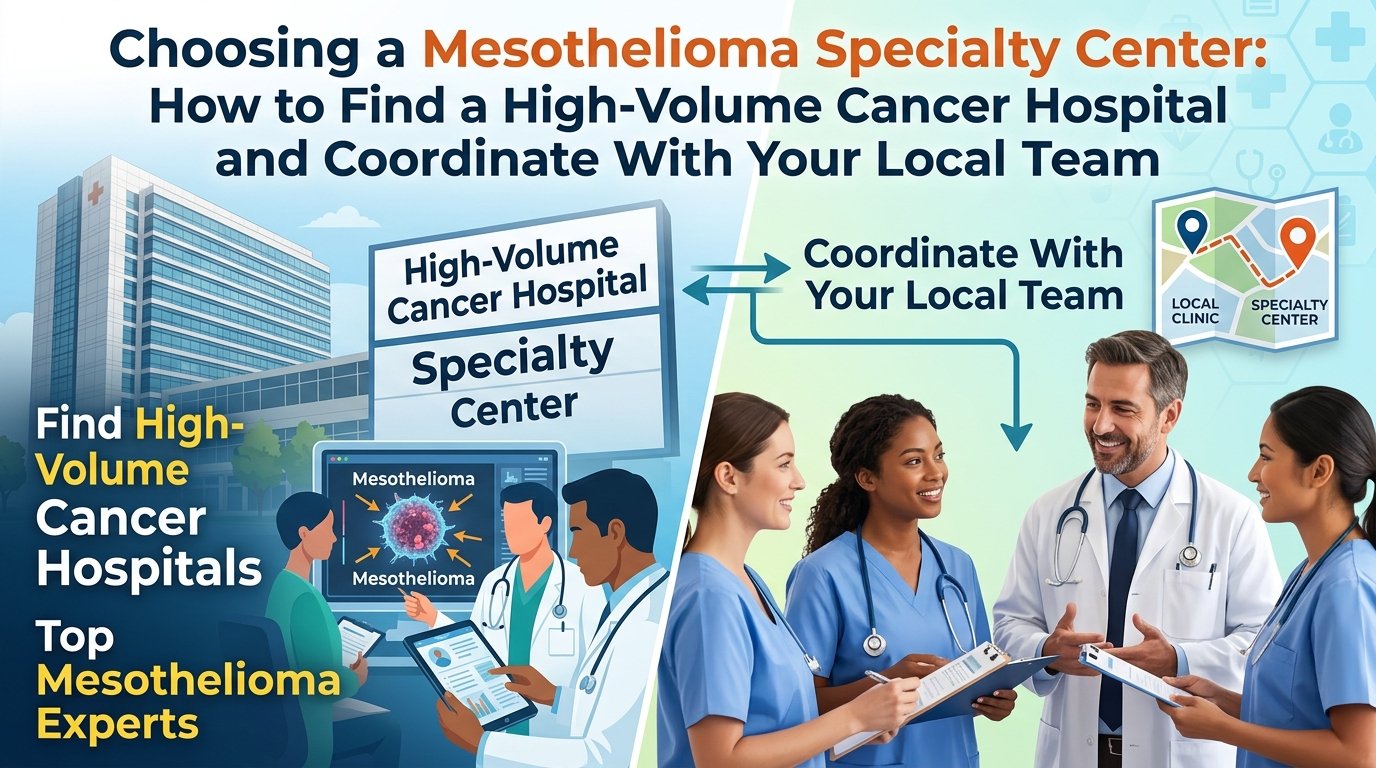
Going to a specialty centre does not mean abandoning your local oncologist. The most common arrangement is a hub-and-spoke model where the specialty centre directs the overall plan and the local team delivers routine chemotherapy infusions, monitors blood work, manages day-to-day side effects, and provides follow-up care between major visits.
This arrangement preserves continuity of care, reduces travel, and uses each team’s strengths. The specialty centre brings deep mesothelioma expertise. The local team brings familiarity with you, accessibility, and integration with your other healthcare. Communication between the two teams should be explicit, with shared records and regular updates.
Second Opinions Are Standard
Even after establishing care at one specialty centre, second opinions at other centres are reasonable for major decisions like surgical approach, eligibility for clinical trials, or transitions between lines of therapy. Most specialty centres expect and welcome second opinions. The patient’s confidence in the chosen plan is part of the treatment, and second opinions reinforce or refine that confidence.
Insurance generally covers second opinions for cancer treatment. The specialty centres have streamlined the process. Bringing your records to a second consultation does not commit you to changing your care; it informs your decision.
A Closing Recommendation
If you have been diagnosed with mesothelioma, prioritise getting a consultation at a high-volume specialty centre early. The travel is worth it. The expertise is worth it. The connection to clinical trials and the latest treatment approaches is worth it. The local relationship can continue alongside specialty care, but the specialty foundation should be in place from the start.
Ask your local oncologist for a referral. If they hesitate, advocate for yourself. The Mesothelioma Applied Research Foundation, Mesothelioma Hope, and patient advocacy organisations can help with referrals. The first step is the appointment. The rest unfolds from there.
This article is for educational purposes and does not constitute personalised medical advice.