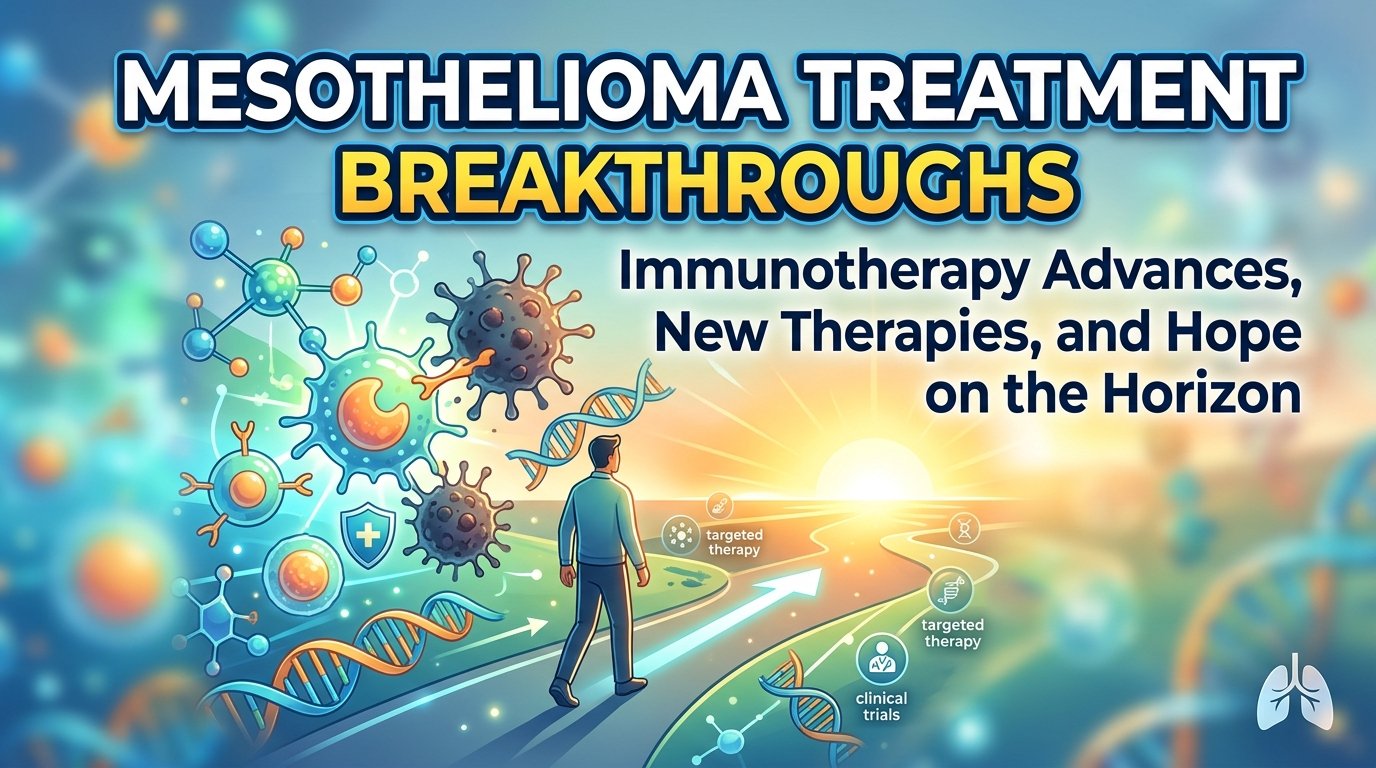
The Future of Mesothelioma Treatment Is Brighter Than Ever
When you hear the word mesothelioma, your mind goes to a dark place. You think about the asbestos companies that hid the truth. You think about the long latency period. You think about the difficult treatments. You think about the prognosis.
But here is what many people do not know. The world of mesothelioma treatment is changing fast. New therapies are being developed. Old therapies are being improved. Patients are living longer than ever before.
Immunotherapy is helping some patients live for years when chemotherapy stopped working. Gene therapy is attacking cancer cells in ways that were science fiction just a decade ago. New surgical techniques are making operations safer and more effective. Clinical trials are offering hope to patients who had few options just a few years ago.
This guide will walk you through the latest mesothelioma research breakthroughs and emerging therapies. You will learn about immunotherapy, targeted therapy, gene therapy, new surgical approaches, and how to access these treatments through clinical trials.
No complicated medical jargon. No false hope. Just clear, honest information about the real advances that are changing the lives of mesothelioma patients.
Why New Treatments Are Needed
Before we talk about the breakthroughs, let us understand why they matter.
Standard treatments for mesothelioma include surgery, chemotherapy, and radiation. For many patients, these treatments work well. They shrink tumors. They relieve symptoms. They extend life.
But for many other patients, standard treatments are not enough. The cancer comes back after surgery. Chemotherapy stops working. The patient is not healthy enough for aggressive surgery.
These patients need new options. They need different drugs. Different approaches. Different combinations.
That is where the breakthroughs come in.

Immunotherapy: Helping Your Body Fight Cancer
Mesothelioma immunotherapy is one of the most exciting areas of cancer research. Immunotherapy does not attack cancer directly. Instead, it helps your own immune system recognize and attack cancer cells.
Think of it this way. Your immune system is like an army. But cancer cells are sneaky. They wear disguises so your army does not see them. Immunotherapy rips off those disguises. Your army can then attack.
Approved Immunotherapy for Mesothelioma
The FDA has already approved two immunotherapy drugs for mesothelioma: nivolumab (Opdivo) and ipilimumab (Yervoy). These drugs are given together through a needle in your arm every few weeks.
Clinical trials showed that patients who received these two drugs lived longer than patients who received chemotherapy alone. Some patients had their tumors shrink significantly. A few had their tumors disappear completely.
New Immunotherapy Drugs Being Tested
Several other immunotherapy drugs are being tested in mesothelioma clinical trials.
Pembrolizumab (Keytruda): This drug has already been approved for other cancers like lung cancer and melanoma. Early trials show it may also work for mesothelioma.
Durvalumab (Imfinzi): This drug is being tested alone and in combination with chemotherapy for mesothelioma.
Atezolizumab (Tecentriq): This drug is also being tested for mesothelioma. Some trials are combining it with other immunotherapy drugs.
Combination Immunotherapy
Researchers have learned that combining different immunotherapy drugs often works better than using just one. The approved combination of nivolumab and ipilimumab is one example.
Other combinations being tested include:
- Immunotherapy plus chemotherapy
- Immunotherapy plus radiation
- Two or three immunotherapy drugs together
- Immunotherapy before surgery (neoadjuvant)
- Immunotherapy after surgery (adjuvant)
Who Responds to Immunotherapy?
Not everyone responds to immunotherapy. Doctors are trying to figure out who will benefit.
Some studies suggest that patients with epithelioid cell type respond better than patients with sarcomatoid. Other studies suggest that patients with certain genetic markers respond better.
Even if you do not know whether you will respond, immunotherapy is worth trying. Some patients who were not expected to respond have done very well.
Targeted Therapy: Attacking Cancer Cells Where They Live
Targeted therapies are drugs that attack specific molecules that cancer cells need to grow. Unlike chemotherapy, which kills all fast-growing cells (including healthy ones), targeted therapies are more precise.
What Is Being Tested
Mesothelin-targeted therapies: Mesothelin is a protein found on the surface of most mesothelioma cells. It is not found on healthy cells. This makes it a perfect target.
Several drugs that target mesothelin are being tested. These include:
- Amatuximab: An antibody that binds to mesothelin. It may help the immune system attack mesothelioma cells.
- BAY 94-9343: An antibody-drug conjugate that delivers a powerful chemotherapy drug directly to mesothelin-positive cells.
Anti-angiogenic drugs: Tumors need blood vessels to grow. Anti-angiogenic drugs block the growth of new blood vessels, starving the tumor.
Bevacizumab (Avastin) is an anti-angiogenic drug that has been tested for mesothelioma. Some studies show it may help when added to chemotherapy.
PARP inhibitors: These drugs block an enzyme that cancer cells use to repair themselves. They have been successful in other cancers. Early trials suggest they may also work for mesothelioma.

Gene Therapy: Changing How Cancer Cells Behave
Gene therapy is a way to treat cancer by changing the genes inside cancer cells. It sounds like science fiction, but it is real.
Suicide Gene Therapy for Mesothelioma
The most common gene therapy approach for mesothelioma is called suicide gene therapy.
Here is how it works. A harmless virus is modified to carry a special gene. The virus is injected into the chest or abdomen where the mesothelioma is. The virus infects the cancer cells and delivers the gene.
Then the patient takes a medication that activates the gene. The activated gene kills the cancer cells from the inside. It is like a ticking time bomb inside the cancer cells.
Clinical trials of suicide gene therapy have shown promising results. Some patients lived longer than expected. A few had their tumors disappear.
Other Gene Therapy Approaches
Oncolytic virus therapy: This uses viruses that infect and kill cancer cells while leaving healthy cells alone. The viruses also stimulate the immune system to attack the cancer.
CAR T-cell therapy: This is actually a type of gene therapy and immunotherapy combined. Doctors remove some of your own immune cells. They genetically modify them to recognize and attack cancer cells. Then they put them back into your body.
CAR T-cell therapy has been very successful for some types of leukemia and lymphoma. Researchers are now testing it for mesothelioma. Early results show it is safe and can shrink tumors.
New Surgical Approaches
Surgery has always been an important part of mesothelioma treatment. But traditional surgeries are very aggressive. They are not right for everyone. Recovery is long and hard.
Less Invasive Surgeries
Surgeons are now using less invasive techniques for mesothelioma.
Video-assisted thoracoscopic surgery (VATS): This uses small incisions and a camera. The surgeon does not need to open up the chest completely. Recovery is faster. There is less pain.
Robotic surgery: Robots allow surgeons to operate with more precision through small incisions. Robotic surgery is being used for both pleural and peritoneal mesothelioma.
Lung-Sparing Surgery
Traditional pleural mesothelioma surgery often requires removing the entire lung. This is called an extrapleural pneumonectomy (EPP). It is a big surgery. Recovery takes a long time.
Many surgeons now prefer a lung-sparing surgery called pleurectomy with decortication (P/D). This surgery removes the pleura (the tissue around the lung) but leaves the lung itself. Recovery is easier. It is safer for many patients.
HIPEC Advances
HIPEC (Heated Intraperitoneal Chemotherapy) is already a standard treatment for peritoneal mesothelioma. But researchers are testing improvements.
- Different chemotherapy drugs for HIPEC
- Different temperatures
- Adding immunotherapy drugs to the HIPEC solution
- Repeated HIPEC for patients who relapse
Tumor Treating Fields (TTFields)
Tumor Treating Fields use low-intensity electrical fields to disrupt cancer cell division. The electrical fields are delivered through electrodes placed on the skin.
This treatment has been approved for a type of brain cancer called glioblastoma. Researchers tested it for mesothelioma.
The clinical trial results were positive. Patients who received TTFields plus chemotherapy lived longer than patients who received chemotherapy alone. The treatment was safe. Side effects were mostly mild skin irritation.
The FDA has now approved TTFields for mesothelioma. This is the first new treatment approved for mesothelioma in many years.
Photodynamic Therapy
Photodynamic therapy (PDT) uses light to kill cancer cells. Here is how it works.
A special light-sensitive drug is injected into your body. The drug collects in cancer cells more than in healthy cells. Then, during surgery, a special light is shone on the area where the cancer is. The light activates the drug. The activated drug kills the cancer cells.
PDT has been tested for pleural mesothelioma. Some studies show it may help patients live longer when combined with surgery.
How to Access New Treatments
New treatments are not available everywhere. They are being tested in mesothelioma clinical trials. A clinical trial is a research study that tests a new treatment.
Finding Clinical Trials
There are several ways to find clinical trials for mesothelioma.
ClinicalTrials.gov: This is the largest database of clinical trials in the world. It is free to use. Search for “mesothelioma” to find trials.
Mesothelioma Applied Research Foundation: This organization has a clinical trial finder and patient navigators who can help.
Top mesothelioma treatment centers: The best centers always have clinical trials. When you call for a consultation, ask about their trials.
Is a Clinical Trial Right for You?
Clinical trials have potential benefits and risks.
Potential benefits:
- Access to a new treatment not available elsewhere
- The new treatment may work better than standard treatments
- Close monitoring by a research team
- Helping future patients
Potential risks:
- The new treatment may not work
- The new treatment may have unknown side effects
- Extra visits and tests
- Travel may be required
Talk to your doctor. Talk to the clinical trial coordinator. Make an informed decision.
Real Stories of Hope
Clinical trials are not just research. They are real people getting real treatment.
The immunotherapy success: A 64-year-old man with pleural mesothelioma had already tried chemotherapy. His cancer came back. He joined a clinical trial testing nivolumab and ipilimumab. Within three months, his tumors had shrunk by more than 60 percent. Two years later, he is still doing well.
The gene therapy patient: A 58-year-old woman with peritoneal mesothelioma had no good options left. She joined a gene therapy trial. The treatment was injected into her abdomen. Her tumors stopped growing. She lived three years longer than her doctors expected.
The TTFields patient: A 71-year-old man was not healthy enough for surgery. He joined the TTFields trial. He wore the electrodes for 18 hours a day. His tumors shrank. He felt better. He lived two years.
Frequently Asked Questions
What is the most promising new treatment for mesothelioma?
Immunotherapy, especially the combination of nivolumab and ipilimumab, is one of the most promising. TTFields is also promising and has already been approved.
How do I find mesothelioma clinical trials?
Start with ClinicalTrials.gov. Search for “mesothelioma.” Filter by location and study status. The Mesothelioma Applied Research Foundation can also help.
Does insurance cover clinical trials?
It depends. Your insurance usually covers routine care costs like doctor visits and scans. The trial sponsor usually pays for the experimental treatment. Ask the trial coordinator for details.
Can I get these new treatments outside of clinical trials?
Some are approved and available. Immunotherapy (nivolumab and ipilimumab) is approved for mesothelioma. TTFields is also approved. Others are only available in clinical trials.
How long does it take for a new treatment to become widely available?
It can take years. The treatment must go through clinical trials. Then the company must apply for FDA approval. Then doctors need to learn how to use it. But some treatments are approved faster, especially for rare cancers like mesothelioma.
Hope and Action
A mesothelioma diagnosis is devastating. There is no pretending otherwise. But the future is brighter than it has ever been.
New treatments are being developed at an amazing pace. Immunotherapy is helping some patients live for years. Gene therapy and targeted therapy are showing real promise. TTFields is already approved and available. Clinical trials are offering hope to patients who had few options just a few years ago.
You do not have to face this alone. There are doctors, researchers, patient navigators, and other patients ready to help you.
Do not give up. Do not stop looking for options. Do not stop hoping.
Talk to your doctor. Contact a mesothelioma specialist. Search for clinical trials. Your next treatment could be just around the corner.
Disclaimer: This article provides general information about new mesothelioma treatments and emerging therapies. It does not constitute medical advice. Every patient’s situation is different. Always consult with qualified medical professionals about your specific treatment needs. If you or a loved one has been diagnosed with mesothelioma, speak with a doctor immediately and ask about clinical trial options. New treatments offer new hope. Do not give up.